Avicii Arena’s Acoustic Modernization: Taking the White Sphere From Echo to Control
.jpg?sfvrsn=fa940549_1)
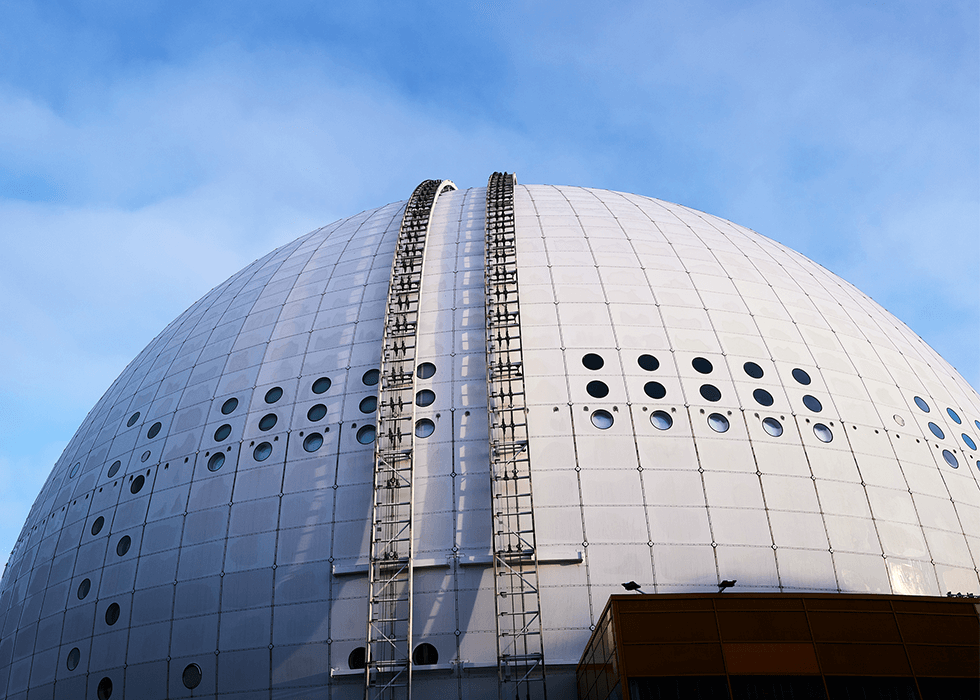
Stockholm's skyline is one of the most iconic in the world, largely due to a peculiar contrast. Alongside the breathtaking church spires, the Stadshuset (City Hall) tower, and the majestic silhouette of the Kungliga Slottet (Royal Palace), stands a sphere that captures the modern within the historical.
This is the Avicii Arena, formerly the Ericsson Globe, rightfully one of the city's landmarks thanks to its bold design. However, it was for years more of a photographed icon than a place to experience. It looked perfect on postcards, but being inside was not pleasant for the ears.
Today, it's alive again, thanks primarily to a new acoustic approach. AVIXA had the chance to explore this transformation in depth during Integrated Systems Europe (ISE) in February 2026 in Barcelona, guided by insights from Anders Jørgensen, Project Executive at the Danish firm Stouenborg—one of the key players behind the modernization.
Interested in more articles about live events and entertainment? Head to AVIXA Xchange!
AVIXA Xchange
Why Did The Sphere Need to be "Saved?"
"It was lacking a lot of infrastructure," Jørgensen explained, "acoustics were not necessarily bad, but it was poor, and it was well known for being not the worst arena around Europe, but some of the more difficult ones to access if you were doing a concert."
Over time, Stockholm unveiled more versatile venues, and the Avicii Arena began to see less use, underutilized for what it meant in the city's collective memory. For a capital city that identifies with this sphere as much as with its waterways and bridges, letting it languish was almost a symbolic wound: it had to be rescued, not just as a building, but as an experience.
This symbolic need was compounded by a very practical one: the events market demands venues capable of transitioning from a hockey world championship to an intimate concert, from an immersive pop show to a corporate event, without sacrificing either sound quality or the connection with the audience. The old configuration didn't meet these expectations; modernization ceased to be a luxury and became a necessity.
.jpg?sfvrsn=3b5fdd9d_1)
Credit: Getty Images/Roland Magnusson
With the Fans at the Core
The project's vision was not only to resolve the acoustic problems of the previous design, but also to transform the venue into a unique experience for fans.
Jørgensen also addressed this side of the project during the talk at ISE:
"One of the major things they were always seeing was that they could not feel the other ones," he said, "they could not feel the opponent, so when they were singing in chants to each other, they were not able to hear each other. So we were looking into: how could we create something that was more intimate? How could we create a mood and some kind of feeling where everything could be together?"
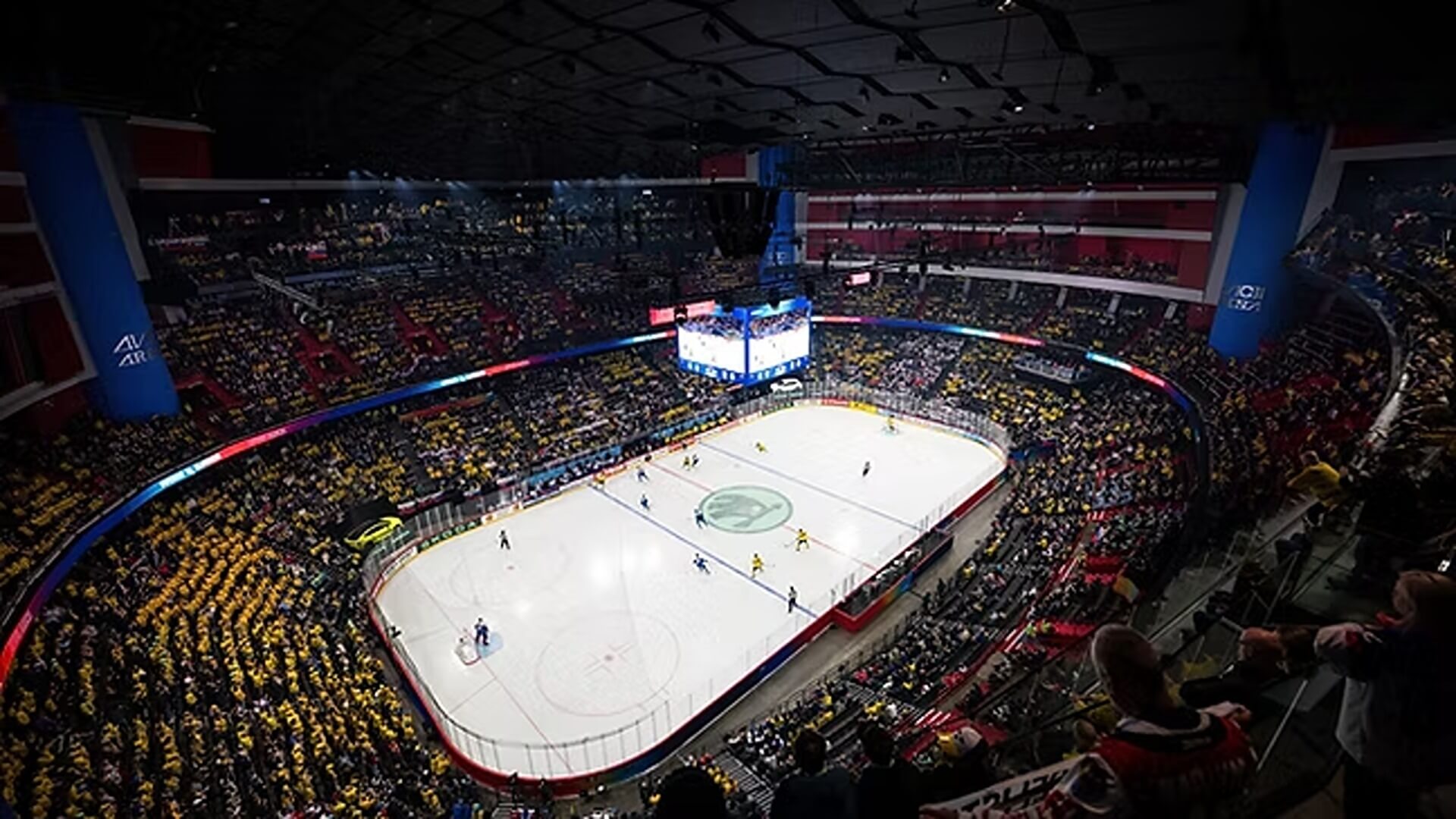
The final solution was as innovative as it was Herculean: installing a movable acoustic roof adapted to the contours of the original structure to better distribute the sound, and a network of microphones and speakers so that fans could literally hear each other, no matter where they were in the arena.
Such a demanding task required coordinated efforts involving multiple teams. It is worth noting that the project encompassed architectural, structural, and operational upgrades across the venue, but its audiovisual transformation became the defining leap forward.
Stouenborg led the AV integration, collaborating closely with American sound-technology developer Meyer Sound. The acoustic concept was developed by the Danish acoustic consultancy Efterklang, while specialized suppliers, including Taiyo Kogyo and Lanaro, also took part in the project.
Source: Stouenborg
Innovation Hanging from the Ceiling
At the heart of the modernization is the new steel ring that runs around the arena at its “equator.” A cable net structure rests on this ring, which supports the retractable acoustic panel system. It integrates a rigging grid capable of accommodating large productions, and includes a walkable mesh that provides a safe working platform at height.
The challenge was twofold: to offer maximum load capacity and flexibility using the minimum amount of material while maintaining the visual transparency of the original dome. This structural lightness is precisely what has earned the project one of its most significant awards.
Suspended from this mesh is the movable acoustic‑ceiling system, made up of 452 panels, each 100 mm thick and built with an insulating membrane that balances acoustic performance with visual refinement. Weighing a total of 40 tons, the panels follow the curvature of the arena and can open or close through an electric chain‑drive mechanism, allowing the ceiling to shift seamlessly between different acoustic configurations.
The key is the speed of transformation: the acoustics can be optimized according to the type of event, and the sound environment can be changed in just 10 minutes. This means that the Arena can go from an explosive hockey game to a clear and warm symphonic concert in the time it takes for a long intermission.
The Invisible Muscle: Meyer Sound Constellation
The major innovation, however, was not only physical but also electroacoustic. The arena incorporated a Meyer Sound Constellation system of unprecedented scale for a sports venue, complemented by the Spacemap Go spatialization platform.
"It is a system that is normally used for changing the preparation time," Jørgensen explained. "Here, we were able to change a little more and use it as an enhancement system. So we took the sound from one side and projected it over to the other, so you're able to hear what's happening around. We did that with roughly around 84 speakers in the ceiling, 72 microphones, and racks and processors all over."
Constellation works as an active acoustic “instrument”: the network of microphones, processors, and distributed speakers captures the sound of the space and reinjects it processed, modifying parameters such as apparent reverberation, clarity, and enveloping sound. At the Avicii Arena, this system was designed to integrate with the new physical architecture, creating a unique immersive experience that serves both the performance and the sound of the audience itself.
If coming up with this whole idea was innovative, the installation process was no less so. Stouenborg had a minuscule window of time for a job of this magnitude.
"We were given a time frame of two weeks to do the complete installation," Jørgensen recalled, "running 10 kilometers of cable and installing almost 100 speakers, 72 microphones, and making it ready for our joint collaboration with Meyer Sound's installation department. So two weeks is nothing. Normally, I would say this would probably take three months."
Stouenborg needed more innovation to overcome the challenge of time:
"We had to figure out how we could build this back home in our warehouse, being able to assemble everything that could be pre-assembled, and then make it fly when we arrived. So it was a whole new approach on that side."
The Fan's Experience Changed Forever
All this technical deployment could remain just a list of specifications if it didn't translate into something very concrete: what someone feels sitting in the stands, or in the new gondolas suspended above the arena floor.
In a hockey game, the roar of the crowd ceases to dissolve into a distant echo and instead coalesces into a compact, resonant roar, almost as if the arena itself were breathing with each play.
At a concert, the artist's voice gains definition; consonants are clear, silences are not filled with background noise, and the bass no longer becomes an indistinct mass. The retractable canopy and movable panels allow the sphere to be acoustically "shrunk," bringing the sound closer to the listener, even in a massive venue.
At smaller events, the arena no longer feels disproportionate. The operator can choose configurations that create more intimate environments, leveraging both the movable architecture and the active system's presets.
Jørgensen summarized it as follows:
"The fan experience developed a lot, and we see that nowadays it's not enough to follow a team and have your favorite player. There's also all these happening around the games, small things happening. You know, through every inning of this ice hockey, there was a huge thing going on, so all that needs to be incorporated into this venue."
When Engineering Also Inspires
The project has not only won over fans; it has also captivated the professional world. The modernization of the Avicii Arena has been distinguished with the 2025 Swedish Steel Construction Award, granted by the Swedish Institute of Steel Construction, for the new cable mesh structure at the “equator” of the sphere. This award highlighted that the acoustic and assembly challenges were solved with minimal material and without distorting the building's iconic geometry.
In the audiovisual field, the Meyer Sound Constellation installation and the integration carried out by Stouenborg have made the project an international benchmark, winning the Innovation Award at the 2025 Stadium Business Design & Development Summit, one of the most influential awards in the sector.
Ultimately, the acoustic modernization of the Avicii Arena is the story of a sphere that, after decades of being viewed from the outside, has been redesigned to be better experienced from within. An entire city recognizes itself in that white shape; now it can also recognize itself in the tuned echo of its own voice, when the goal goes in, when the song swells, when, for an instant, all the noise of the world seems to be the perfect size.
Main image credit: Getty Images/Simon Lofgren
- Share to Facebook
-
Share to X/Twitter

- Share to LinkedIn
- Share with Email