What happens when AI's promises outpace what our physical spaces can really deliver? Espen Løberg, Vice President and General Manager of Collaboration Devices at Cisco, tackled this very question during his keynote at InfoComm 2026.
Løberg's answer is a concept he calls connected intelligence. And over the course of an hour, he made a compelling case that the future of work does not depend on smarter software alone, but on smarter rooms.
Loading...
The Gap Between AI's Promise and the Physical Room
Løberg opened the keynote by noting where we are in the technology arc. “We're moving from the era of chatbots that intelligently answer our questions to agents that are our digital co-workers that conduct tasks and jobs now fully autonomously,” he explained. Just around the corner, he added, sits “the era of physical data, where robots and sensors will be sprinkled all around us.”
That shift carries enormous infrastructure implications and a stubborn problem. “There is a gap between what AI promises and what physical infrastructure currently delivers,” Løberg said. And to make the point land, he asked, “How many of you have walked into a room in your own building and spent the first five minutes fighting the technology?”
His challenge to the audience was this: “What would work look like if the room was just as intelligent as the people in it?”
What Connected Intelligence Looks Like
When agents, people, devices, and networks flow together effortlessly, Løberg said, “it becomes what we in Cisco call connected intelligence.”
The goal is to create an agentic workplace. But what would that look like? It would need to be a space where technology thinks about the work happening in it, adapts to employees' needs, and acts on behalf of IT teams.
For Cisco, the portfolio bringing this to life shares one architecture across every device. The RoomKit Pro G2 anchors large rooms with an AV-over-IP design that connects cameras, microphones, power, media, and control through a single cable. The DeskPro G2 turns individual workstations into fully capable meeting environments, while the BoardPro G3 serves as an all-in-one collaboration hub. Each runs Cisco's fourth-generation NVIDIA module.
Crucially, they aren't passive displays. “These are agentic devices that actively participate in the meeting,” he said. And every device works with whatever meeting platform teams already use.
In one standout demo, Løberg even connected live to a team in Oslo using a RoomKit Pro G2 with six tracking cameras and allowed the system to autonomously produce the meeting, switching camera angles with precision so no one missed a moment.
“This is not AI that detects," Løberg said. “This is AI that acts.”
And the results speak for themselves:
29% reduction in office real estate across key cities
More than $100 million saved annually
40% increase in collaboration spaces
90% reduction in annual energy consumption
Making the Agentic Workplace Practical
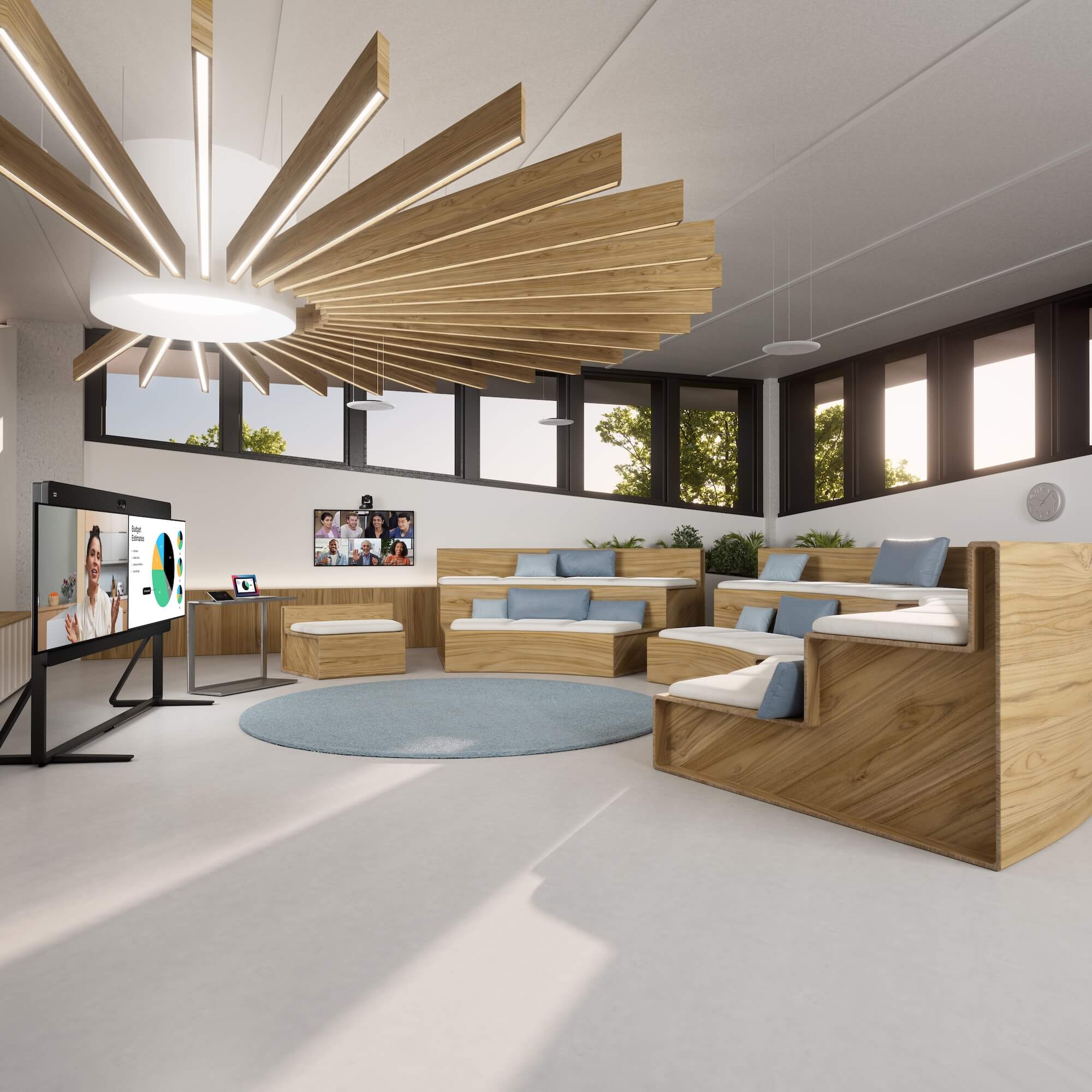
Løberg also mentioned the Cisco Workspace Designer, a free, web-based planning tool that can help organizations map out and configure their collaboration spaces before a single device is installed. With the Designer, users can drag and drop Cisco devices into customizable room layouts and then see exactly how the technology fits together. The tool additionally recommends devices based on room size and use cases.
Rather than working from spreadsheets or disconnected site surveys, teams can open the tool, input room dimensions and intended use, and let it recommend device configurations. From there, the design can be refined collaboratively. The output is a complete, shareable room design.
For organizations standardizing across dozens or hundreds of sites, like Cisco, that consistency is what makes scaling the agentic workplace practical rather than aspirational.
Why It Matters for the AV Industry
Cisco's message at InfoComm 2026 reflects a broader convergence reshaping the industry. The truth is AV systems, collaboration platforms, network infrastructure, and AI are increasingly working together. But agentic features only perform as well as the hardware beneath them.
Løberg's vision of connected intelligence puts the room itself at the center of everything. Because in the agentic workplace, the smartest software in the world still needs a space ready to keep up.