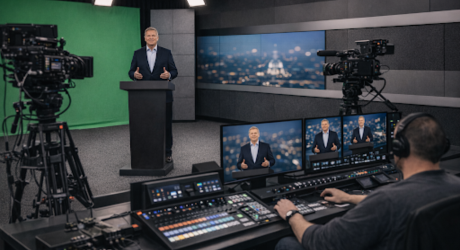
Picture a familiar scene: a corporate boardroom, recently refurbished. Ceiling mic array, pan-tilt-zoom cameras, a Microsoft Teams Rooms stack, and a new feature the client was excited about — a “sentiment dashboard” that grades how the room is performing in real time. Green for engagement. Amber for drift. Red for disengagement.
Now imagine the email from the general counsel. A story has circulated about enforcement action linked to workplace monitoring AI in Europe. IT forwards it to AV. The message is simple: can you confirm we are not exposed?
You cannot answer that quickly. Because if that system infers how people feel in meetings, it has already crossed a legal line under the EU’s AI framework. The prohibition is not upcoming. It is in force. This is what AV integration looks like when the room itself becomes a regulated system — not just the technology inside it.
How the EU AI Act Applies to AV Systems
The EU AI Act entered into force in August 2024, but its obligations apply in layers. The prohibition on workplace emotion-recognition systems under Article 5 is already enforceable. General-purpose AI obligations followed. Transparency duties under Article 50 apply across all deployed systems that interact with users. High-risk system requirements under Annex III are phased in over 2027 and 2028, depending on system type.
The most important misconception in the AV sector is that this framework is still “incoming.” Multiple layers are already live, and the workplace emotion-inference prohibition — the one most directly relevant to meeting-room AV — is among the earliest to have taken effect. These duties apply not just to vendors but to deployers, meaning the client operating the system. That pulls the integrator into the chain of responsibility, because integrators define what is installed, enabled, and commissioned.
The timetable for each obligation varies, and that timetable shifted significantly in May 2026. For a precise account of which deadlines moved and in which direction, the companion to this piece — The EU AI Act’s 2027 Extension Doesn’t Cover What You Think It Covers — covers the revised enforcement schedule in full.
The Core Prohibition: Emotion Inference in the Workplace
Under Article 5(1)(f), systems that infer emotional states in workplaces or education settings are prohibited, with narrow exceptions for medical or safety contexts. This is the line AV teams keep missing. It does not ban microphones. It does not ban analytics. It bans inference of emotional state from biometric or behavioural data — stress, engagement, frustration, attention, or mood derived from voice, face, or movement. A transcript system captures words. A prohibited system interprets the feelings behind them.
The penalty ceiling sits at €35 million or 7% of global turnover, placing it in the highest enforcement tier. The geographic scope is deployment-based: if the system operates in a German HQ, a Spanish university, or a Dutch boardroom, it is in scope regardless of where the vendor is headquartered. The safety carve-out is narrow. Driver fatigue detection in logistics may qualify. “Meeting engagement optimisation” does not. The sentiment dashboard in the opening scenario is not a borderline case. It is prohibited.
Loading...
Article 50: The Transparency Layer
Article 50 is where most AV deployments become operationally exposed beyond the outright prohibitions. Systems interacting directly with people must make it clear when AI is present. Generative systems must label their outputs. Deployers of any permitted biometric systems must inform affected individuals. Deepfake content must be disclosed. The enforcement ceiling here sits at €15 million or 3% of turnover.
In AV environments this translates into three real obligations. Meeting-room systems that generate or transform content must ensure users know when AI is present at the point of interaction — not buried in policy documents. Synthetic media, including AI avatars, voice cloning, and generated training content, must be disclosed as artificial. Where biometric systems are permitted at all — rare in workplace contexts — disclosure is the deployer’s responsibility.
The practical risk is not the fine level. It is a system design mismatch: the integrator configures features, but the compliance obligation lands on the client — who then interrogates the integrator when something is unclear. That conversation is a great deal worse when the integrator has no documentation of what was enabled at commissioning.
What Has to Come Out of Meeting Rooms
AV systems need to be audited feature by feature, not by product category. The function determines the risk classification, not the label on the box.
The prohibited category covers emotion inference from voice, face, or behaviour; engagement scoring dashboards; stress or attention monitoring; sentiment analytics layered onto meeting platforms; and wearables feeding emotional state into workplace systems. If it interprets internal mental state from biometric signals, it is not compliant for EU workplace use.
The transparency-required category — permitted but requiring explicit user disclosure — includes AI avatars and synthetic presenters, voice cloning and deepfake content, AI meeting assistants, and any permitted biometric classification system. Disclosure must occur at the point of interaction, not in terms and conditions.
Low-risk features — transcription, noise suppression, translation, non-emotive summarisation, auto-framing cameras, beamforming microphones — carry no special disclosure requirements. The problem is that vendors often bundle these inside “smart experience” packages that quietly include higher-risk analytics layers. The integrator who commissions the package without auditing its components owns the resulting exposure.
Who Carries Responsibility
The AI Act splits roles between providers and deployers while most integrators sit between both. Under Article 26, deployer obligations include ensuring systems are used as intended, maintaining logs, and informing affected individuals where required. Those obligations land with the client — but the integrator who specified and configured the system is the first person the client calls.
You are not the vendor of the AI model. You are not the end user. But you define the deployed configuration, and that is where liability moves you into the frame. If you enable a feature beyond its intended use case, you may shift into deployer responsibility for that function. If you materially alter intended use through configuration or integration, you may trigger substantial modification logic, similar to product liability principles now embedded in EU law. Integrators are no longer neutral installers. They are system designers in the eyes of regulators.
The Vendor Question That Should Already Have Been Asked
Every supplier in your AV stack needs to answer two questions in writing. First: which features in your platform infer emotional or psychological states from biometric or behavioural data, and are they active by default in EU workplace deployments? Second: what technical controls ensure those features are disabled in EU configurations, and how do you support Article 50 compliance for the features that remain?
If the answer is vague, the system is not compliant — it is just untested. Governance has to be a product design question, not a post-deployment audit. The integrator who asks these questions before commissioning is in a fundamentally different legal position to one who does not.
What Integrators Must Have in Place
Three operational shifts matter, and none of them are optional. The first is a per-room AI feature inventory documenting which features are enabled, their default state at commissioning, their AI Act risk classification, and who owns ongoing compliance monitoring. Without it, the integrator has no defensible position when the client’s legal team asks.
The second is a redesigned handover conversation. Clients must be told explicitly when AI is present, what must be disclosed to users, and where that disclosure appears in the actual experience. A notice on a door is not sufficient. Disclosure must occur at the first interaction with the system and must be documented as having occurred.
The third is rewritten contract language defining which AI features are active at handover, which are disabled, who controls future updates, and who is responsible if a vendor update re-enables restricted functionality. Ambiguity on any of those points is a direct liability exposure.
When Compliant Systems Become Non-Compliant
Most integrators treat compliance as something signed off at commissioning. Under the AI Act, the risk profile of a meeting room changes the moment a vendor pushes an update. Camera firmware updates silently. The collaboration layer refreshes monthly. AI features are toggled server-side without a truck roll. A system that is fully compliant at commissioning can become non-compliant weeks later without anyone in the building noticing.
If an update re-enables an engagement scoring feature, or introduces emotion inference as part of a “meeting quality enhancement” package, the system has not just drifted technically. It has changed legal category. Regulators will ask who specified the system, who approved its configuration, and who had a duty to understand what changed. Compliance cannot be a one-time checklist. It has to be a maintained inventory with version tracking, feature-state logging, and explicit re-approval triggers when core AI functions change.
Without that, integrators are certifying a moment in time while the system they installed moves underneath them. As the ISE 2026 AI governance sessions covered by AVIXA made clear, the dominant practitioner concern is not whether AI is present — it is whether it can be audited. Article 50’s traceability requirements are the only stable defence between a compliant deployment and a retrospective enforcement action.
My Verdict
The evidential burden has shifted. AV integrators will be judged not by what they installed, but by what they can prove those systems were doing.
If you cannot produce a clear inventory of AI functions in a deployed room — what is enabled, what is disabled, and what disclosures were made — you are already exposed. Not approaching it. Already there.
The workplace emotion-recognition ban is not a future risk. It is in force. Any live deployment of sentiment analysis or engagement scoring in EU workplaces is in breach of Article 5. The practical response is the immediate removal of prohibited features, a documented audit of existing rooms, and written confirmation from vendors on feature behaviour in EU deployments.
AV integration has entered a phase where the room itself is a regulated system. The question is not whether the Act applies to your deployments. It is whether you can demonstrate that you knew it did.