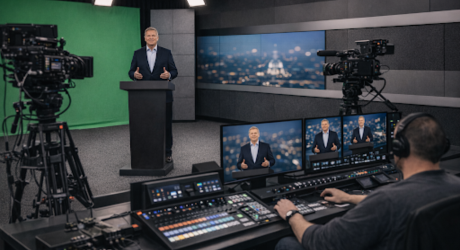
An enterprise client in Frankfurt called their new room a “communications suite.” Their brief described a CEO lectern, two camera positions, a green screen, and a “professional look.” Three months after handover, the client’s internal media team arrived with a broadcast engineer, a vision mixer, and a list of integration points that nobody had priced. The room worked. The project did not.
That scenario, in some variation, repeats across European corporates right now. The brief has changed. The language in which clients describe what they want has not always caught up — and neither, in too many cases, has the integrator’s response to it.
ISE 2026 dedicated an entire summit programme to this shift. The Broadcast AV Summit at ISE, presented in association with IABM, aimed squarely at corporate organisations and brands wanting to become their own broadcasters — not at television stations. InfoComm 2026 is running a dedicated Enterprise AV and Broadcast track covering IP-based production and in-house studio design. These are not niche sessions. They are the industry signalling where a material share of project work is heading.
Loading...
The Numbers Behind the Shift
The clearest single data point came from the NAB Show 2026. More than 13,000 corporate media professionals attended— nearly double the 2025 figure — and NAB introduced a dedicated Enterprise Video Strategies track for the first time. The post-show report from Futuresource Consulting concluded that the convergence of Pro AV and broadcast is no longer a trend. It is an established reality, with enterprise clients now expecting broadcast-quality output from Pro AV budgets and Pro AV teams.
AVIXA’s Industry Outlook and Trends Analysis puts the Broadcast AV category at $43 billion in 2025, projected to grow at a compound annual rate of 5.46% through 2029. That figure reflects both corporations adopting broadcast technologies and broadcast organisations adopting AV-over-IP infrastructure. Both flows converge in the same room type: the permanent in-house corporate studio.
The picture varies by geography in ways that matter commercially. The UK is furthest along, driven by financial services and media-adjacent corporates in London that have been building in-house production capability since the pandemic. Germany is catching up fast, particularly in manufacturing and professional services firms, where executive communication to global workforces has become a board-level priority. The Nordics present a different dynamic: a smaller base of large corporates, but a higher baseline of AV and IT literacy among in-house teams, which compresses the training phase and raises the technical bar for what the brief expects from the system on day one.
For European integrators, this is not an abstract market figure. It is a change in what clients mean when they say “studio.” A senior leadership team that watched competitors publish polished CEO video content through the pandemic never quite returned to the assumption that a decent camera on a laptop was sufficient. Three years on, "we want to look like a broadcaster" is a live project brief — and it is landing on integrators' desks right now.
What the Brief Actually Contains
The problem is not that integrators cannot build broadcast-grade corporate studios. Many can, and do it well. The problem is that the brief often arrives dressed as something simpler — and the integrator’s scoping process targets the simpler version.
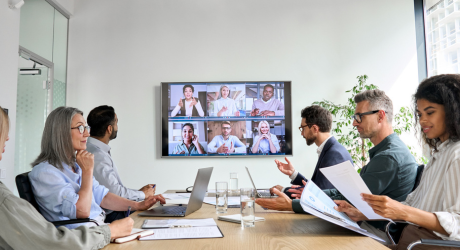
When a corporate communications team asks for a “professional studio,” they typically mean several things simultaneously. They want consistent, repeatable lighting that makes talent look broadcast-ready without a crew on set every morning. They want camera positions that handle a single presenter, a panel of three, and a remote guest without a technician in the room for each configuration. They want audio that works for both the polished pre-recorded CEO address and the live all-hands with 3,000 remote attendees, where latency and signal integrity are not negotiable.
And they want the whole thing to feed into their existing Microsoft Teams or Zoom infrastructure while also outputting clean signals to their post-production workflow. That last requirement is where the brief parts company with a standard AV room. The signal chain in a broadcast-grade corporate studio touches an IP production infrastructure — vision mixers, AV-over-IP routing, graphics and lower thirds, stream encoding — that a standard meeting room specification does not include. Pricing only the AV side of that chain and leaving the broadcast side for someone else to scope is how projects exceed budget at handover.
Where the Labour Assumptions Break
Kit costs are visible. Labour costs are where the real divergence lies, and they split across three phases: commissioning, training, and ongoing operation.
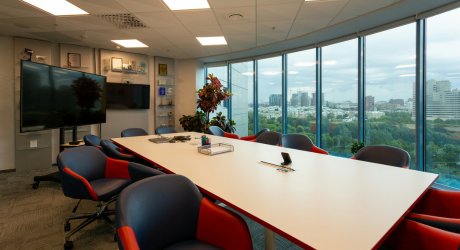
Commissioning a broadcast-capable space takes longer than commissioning a meeting room of equivalent size, even when the hardware list looks similar. The integration between camera control, audio routing, vision mixing, and stream delivery requires testing against real production scenarios, not just a signal-path check. A PTZ camera that tracks correctly in an empty room may behave differently when talent moves between a lectern and a seated position, with multiple light sources and a changing background. Getting that right requires time on site with talent, not a bench test.
Training is the second underpriced phase. The internal team running a corporate broadcast studio is rarely a broadcast engineer. It is a communications manager, a video producer from a marketing background, or, in smaller organisations, an executive assistant handed the remote control. The operators running corporate town halls and executive communications are not AV professionals. Designing a system they can operate reliably across a range of production scenarios — and training them to do so — is a materially different engagement from handing over a meeting room to a facilities team.
Ongoing support is the third gap. Broadcast-grade systems in a corporate environment generate support calls different in character from meeting room faults. A camera offline before the CFO’s investor call is a P1 incident. A lighting rig that shifts colour temperature between recordings creates a post-production problem that the communications team traces back to the integrator. Scoping the support contract for a corporate studio demands the same rigour as scoping support for a control room, because from the client’s perspective, that is what it is.
The IP Infrastructure Conversation You Are Having, Whether You Initiate It or Not
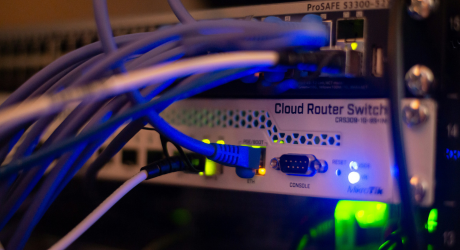
The technology stack behind a broadcast-grade corporate studio is now almost entirely IP-based. NDI, Dante AV, IPMX, and SMPTE ST 2110 are mature enough to deliver genuine interoperability between broadcast and AV workflows. That is good news for integrators who understand the IP layer. It is a problem for those who do not.
The enterprise network team enters this conversation from the start, whether the AV integrator invites them or not. A corporate studio running AV-over-IP at broadcast quality requires guaranteed bandwidth, multicast routing, and network segmentation that a standard enterprise IT team may not have provisioned. When the integrator arrives to commission and finds the network cannot carry the traffic, someone has to return to the client with a revised scope. That conversation is considerably easier before the kit arrives on site.
The practical implication is a discovery process that positions the IT team as a primary stakeholder, not a secondary one. Questions about switching capacity, multicast support, and quality of service policies need answers before the specification is written. At IBC 2025, the integration between AV control systems and existing enterprise network infrastructure emerged as the primary operational friction point in financial services deployments — precisely because the AV and IT scopes were not aligned from the outset.
Qualifying the Brief Before You Price It
The integrators winning broadcast-grade corporate studio work are not necessarily those with the deepest broadcast credentials. They are the ones who qualify the production ambition in discovery, before the specification locks.
The reason most teams skip this step is not ignorance, but rather category assumption. A brief that arrives through the usual channel, from the usual contact, using the usual language, gets processed as the usual project type. The discovery questions that would surface the broadcast ambition are never asked because nobody flagged that this job was different. By the time the gap is visible, the price is signed, and the scope is fixed.
Three questions surface the gap between “professional studio” and “broadcast studio” quickly. First: who operates this space on a typical production day, and what is their technical background? The answer defines control surface complexity and training scope. Second: what is the output — is this feeding a UCC platform, a streaming endpoint, a post-production workflow, or all three simultaneously? The answer defines the signal chain. Third: what is the operational consequence of a technical failure during a live event? A CEO town hall with 3,000 remote attendees carries a different resilience requirement than a weekly team briefing recorded for asynchronous viewing.
Recommended Reading: Strategic Path: NAB 2026 Confirmed What Pro AV Integrators Already Suspected: Every Enterprise Is Becoming a Broadcaster
Broadcast-grade does not require broadcast budgets. Modular, IP-native systems deliver consistent output at price points that work for European corporates. But broadcast-grade does require broadcast-grade scoping, and that is a discipline, not a specialist credential. None of these three discovery questions require a broadcast background to ask. They require the discipline to ask them before pricing, and the confidence to return with a revised scope when the answers change the picture.
My Verdict
The corporate broadcast studio is not a specialist niche for integrators with television experience. It is a mainstream project type arriving in your pipeline dressed as a communications room. The integrators pricing it correctly ask three questions in discovery that most teams skip: who operates it, what does it output, and what fails if it goes down mid-broadcast. If you are not asking those questions before you quote, you are pricing the room. You are not pricing the job.