

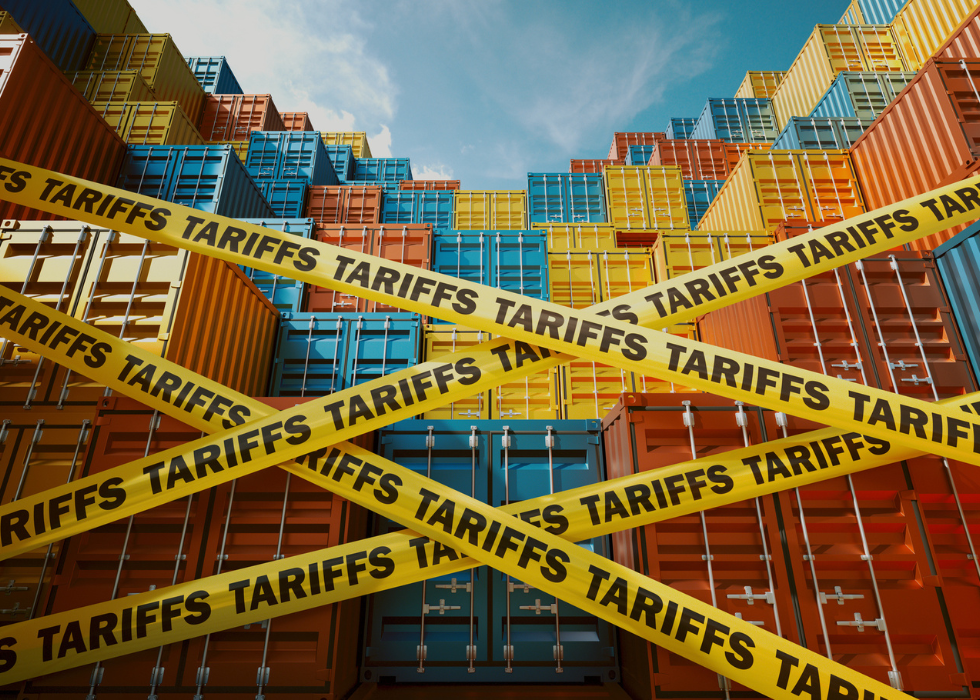
9 Tariff-Driven Challenges Putting the AV Industry to the Test
.jpg?sfvrsn=fa940549_1)
The AV industry is facing a silent but profound transformation: tariffs. No longer just background noise from trade policy, tariffs are now a structural variable that influences margins, investment decisions, and market strategies across the entire value chain.
What challenges does this new landscape create for the AV industry? Several world‑renowned experts explored the issue at Integrated Systems Europe (ISE) 2026 in Barcelona, offering insights that were both illuminating and cautionary.
1. Margin Erosion and Price Pressure
The first challenge is direct: tariffs are eroding the margins of professional audiovisual equipment (pro AV) manufacturers, especially in North America. There are cases where a media player manufacturer operating with 12% margins has had to absorb an additional 10% in import tariffs, practically eliminating its profitability.
This pressure is exacerbated in an environment where price increases are socially and commercially constrained and overlap with other tensions, such as a three-fold increase in the cost of key components (e.g., memory), leading some suppliers to abandon markets like the US due to sheer economic unviability.
2. Geographic Reconfiguration of Production
Tariffs are accelerating the relocation of manufacturing to regions with a more favorable approach to tariffs. Large manufacturers have responded quickly, relocating production lines from China to Mexico, Vietnam, Indonesia, and other countries to minimize the impact of tariffs.
However, this nearshoring or friendshoring involves multi-year investments and numerous ramp-up problems: capacity fluctuations, quality challenges, and the risk of supply disruptions during the commissioning of new projects. All of this translates into greater operational and financial uncertainty for the sector.
3. Tariff Complexity and Risk of Reclassification
The third challenge is the increasing complexity of tariff structures and HS (Harmonized System) codes, which determine the applicable tariff for each product. Seemingly minor design changes—such as adding more aluminum to a chassis or integrating a new chip—have led to reclassifications and abrupt changes in the tariff rate applied to the same media player model.
This forces manufacturers to dedicate resources to tax and customs engineering: reviewing HS codes product by product, redesigning equipment to fit into tariff lines with lower rates, and monitoring the country of origin of each component. This is a very demanding task, especially considering that a significant portion of all components still comes from China, even if final assembly takes place elsewhere.
4. Structural Dependence on the Chinese Supply Chain
Although tariffs are pushing companies to diversify their supply chains, the AV industry—particularly in LCD, LED, and microLED displays—remains deeply tied to China’s manufacturing ecosystem, which is among the most affected by these measures. Today, an estimated 80–90% of LCD cells—the component that represents the bulk of a display’s value—are still produced in China.
Speaking about this issue during ISE 2026, Florian Rotberg, Managing Director of Invidis Consulting, described the dependence on the Chinese market in absolute terms:
"There's no alternative," he said. "Even if you have your plant in Mexico or in Vietnam, the cell itself comes 80 to 90% from China. And that's the main core. I mean, that's the biggest value of a bill of materials."
The concentration is similar in LED and microLED: chips, packaging, and a large part of the subcomponent chain remain anchored in China, whose cost structure and public support are difficult to replicate. Initiatives are emerging in India and other countries to build their own capacity, and there are even projects designed to export to Europe under more favorable tariff regimes. Yet, the impact of these efforts remains limited when compared with China’s scale, and the overall landscape is unlikely to shift significantly in the short term.
5. Global Competition and Selective Price Wars
China’s excess production capacity and the need to redirect goods originally intended for the U.S. market have intensified its commercial presence in other regions. Despite being hit hard by tariffs, Chinese manufacturers continue to offer extremely competitive prices, largely thanks to their massive industrial capacity and strong public backing.
For producers elsewhere who already face higher financial and labor costs, competing under these conditions is an increasingly tough challenge, especially considering that they also face significant tariff pressure.
6. Price Volatility and the Breakdown of the Fixed-Price Model
Cost volatility stemming from tariffs and component prices has broken the traditional long-term fixed-price model. System integrators are beginning to quote projects with "daily prices" indexed to memory indicators or other inputs, foregoing the guarantee of stable prices in five- to seven-year contracts. This is an issue that clashes with the expectations of many end customers.
This instability delays investment decisions: end users are postponing projects, preferring to wait for "price stability” before committing their budgets. This creates pent-up demand that is only released when the delay is no longer viable (on the verge of store openings, mandatory deployments, etc.).
7. Financial Strain on Integrators and Burden Sharing
Pricing issues generate a silent conflict over who bears the additional cost: manufacturers, distributors, integrators, or end customers. In theory, integrators should absorb a significant portion of the variation in already committed projects. However, this is not what is happening.
"In practice, it's not the integrator who's digesting it," Rotberg said about this topic. "They can't, to be honest. They can't. That's something that these guys always say: 'You have to do that, it's your customer.' But that's theoretically ... At the end of the month, at the end of the quarter, it's a vendor at the end of the day who is carrying most of that. And it's not fun for them. Absolutely not."
We’ve also seen the workload being spread more evenly across the channel:
- Manufacturers adjust prices and offer selective discounts or rebates.
- Distributors use stock acquired at pre-priced levels to "subsidize" key operations.
- Integrators reconfigure solutions or reduce project scope.
- The end customer, who in some instances increases the budget but also scales back the ambition of the deployment.
8. Inventory Management and the Depletion of Cheap Stock
Many industry players resorted to front-loading before the new tariffs took effect. The strategy included bringing forward shipments to the United States and other relevant markets to create inventory buffers. This cheaper stock temporarily mitigated the impact on the supply chain, especially for integrators locked into fixed-price contracts, but these reserves dwindled as 2025 progressed.
By early 2026, much of the available inventory already carried the new cost levels. It has raised replacement costs and put upward pressure on prices exactly when pent-up demand began to emerge, and postponed projects could no longer be delayed. This has forced companies to deal with delicate decisions about how much stock to carry and what risk horizon to accept.
9. Regulatory Uncertainty and Investment Blockage
Beyond the specific level of tariffs, the central problem is their unpredictability. Building a new screen or LED plant requires three to five years of planning and multimillion-dollar investments, but companies hesitate to commit capital when tariff rules can change in a matter of months.
This uncertainty doesn't just affect AV hardware manufacturers: large retail, hospitality, and entertainment companies—intensive users of AV solutions—are also halting or downsizing digital signage projects, immersive rooms, and large-scale display upgrades. In other words, the unstable environment has led to a slowdown in technological modernization and service innovation.
Bonus Insight: Best Practices to Stay Competitive
In the current context, the AV industry can't wait for tariffs to disappear; it must professionalize its economic and commercial management to coexist with them. Some best practices emerging from the sector's recent experience include:
- Designing brand-neutral solutions: Developing projects that allow for replacing screen and component brands without rebuilding the entire architecture, avoiding excessive dependence on a single manufacturer, and gaining negotiating power in the face of tariff or price changes.
- Managing pricing with indexation mechanisms: Incorporating contractual clauses that link a portion of the price to component indices or time-based milestones, instead of locking in fixed rates for five or seven years.
- Investing in customs and tax excellence: Engaging specialists in HS codes, rules of origin, and trade agreements to optimize the tariff classification of each product and anticipate regulatory changes.
- Enhancing communication across the value chain: Sharing cost, inventory, and risk information more transparently among manufacturers, distributors, and integrators to coordinate pricing strategies, discounts, and delivery times.
- Strengthening recurring services and models: Going beyond simply "providing screens" to integrate content, analytics, maintenance, cloud, and manage services to diversify revenue streams and reduce dependence on pure hardware margins.
- Planning for several scenarios, not "one-off bets": Working with various tariff and exchange rate assumptions, and testing in advance how each would affect the P&L of key lines, so that stop-loss and repositioning decisions are predefined, not improvised.
Those who accept that the current tariff regime is a structural condition—and not a temporary setback—can transform these challenges into a competitive advantage: that of being an AV organization capable of continuing to invest, innovate, and deliver value in a world where stability can no longer be taken for granted.
Image credit: Getty Images/Stanislav Gvozd
- Share to Facebook
-
Share to X/Twitter

- Share to LinkedIn
- Share with Email




.jpg?sfvrsn=b87c272_1)