

Behind the Scenes of Cirque du Soleil’s Alizé: Unveiling The AV Sorcery
.jpg?sfvrsn=fa940549_1)
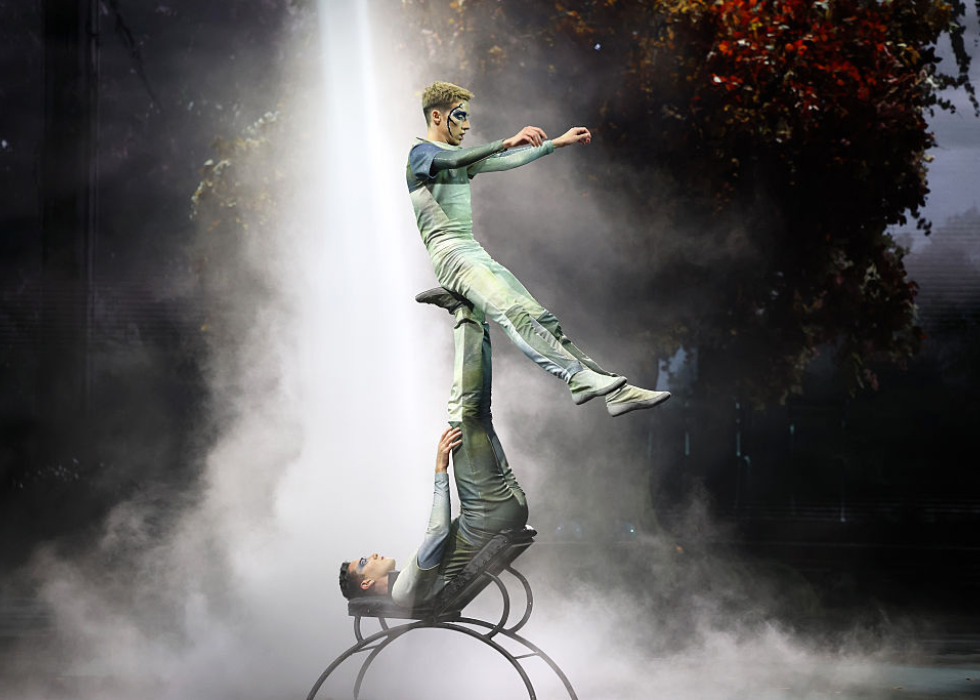
A theatrical‑scale magic trick—that’s Alizé, the latest Cirque du Soleil production: a show where the trick isn’t only onstage, but embedded in every lens, every pixel, and every line of code that sustains the illusion of “seeing the invisible.”
From the audience, everything looks effortless; behind the scenes, the AV industry works at its limits, so that people leave not asking, “How did they do it?” but “Did I really see what I just saw?”
During the recent Integrated Systems Europe (ISE) 2026 in Barcelona, attendees had the opportunity to hear insights from Simon Lachance, Director of Technical Design at Cirque du Soleil, who was able to bring the magic behind the effect to the front stage, and left everyone determined to see the show.
A circus built with light
Alizé is Cirque du Soleil’s first European residency, housed at the Theater am Potsdamer Platz in Berlin—a real theater pushed to its last beam to turn it into a machine of acrobatics and illusionism. The core of the show is an extremely ethereal idea: making people disappear onstage, in full view of the audience.
That concept forces technology to stop being a simple support and become part of the trick itself. That’s where the term “Acromagic” comes from: a blend of contemporary circus techniques with magie nouvelle, where choreography is drawn not only by the body but also by light, projection, and automated scenery.

The story: a journey into the invisible
The show follows Alizé, a dreamer swept by a gust of wind into a world where the invisible takes shape: doubts, desires, versions of himself that appear and disappear in a kind of intimate diary made of acrobatic numbers. What for a casual spectator is “a poetic story of self‑discovery,” for a technician is a map of lighting, video, sound, and effects cues that must fall with the precision of a Swiss watch.
The narrative unfolds without words, relying on visual dramaturgy: projections that turn the stage into a storm, an infinite tunnel, or a childhood bedroom; LED panels that blend with physical scenery; shadows calculated to the millimeter to hide the trick exactly when the protagonist crosses from one world to another.
Projection: painting an entire theater
Paradoxically, Alizé began on paper as a show “without video projection.” But as creation advanced, every idea demanded images: textures in the air, breathing backgrounds, appearances and disappearances that needed more than smoke and curtains.
The solution was to fully embrace the logic of large‑scale immersive shows:
- A projection system based on Epson EB‑PU2220B 20,000‑lumen large‑format laser projectors, designed for major productions.
- Eight stacked units create a dynamic canvas that covers the floor, scenic elements, and at times even the performers’ bodies.
In industry terms, this is a large‑venue projection and multi‑projector setups with real‑time overlap and alignment: several projectors aimed at the same surface, unified through edge blending and warping. The same technology used for architectural mapping at trade shows allows a storm in Alizé to swallow an acrobat or a six‑meter tornado to engulf the characters.
This idea became one of the show’s milestones, but coming up with it was the easy part. As Lachance recalled at ISE:
When, creatively, we come up with that idea ... there's not, like, a vendor that has a tornado off the shelf somewhere that you can call. Right? And, you don't even know what kind of vendor to turn to. So, we first did some research and development analysis to figure out the best ways to approach this challenge. And then we started to understand what our tornado would be.
LED that doesn’t want to look like technology
The key isn’t just luminous power—it’s chromatic stability and resolution. The audience is so close that any color shift or blur breaks the illusion. That’s why Cirque works hand‑in‑hand with manufacturers, fine‑tuning contrast, gamut, and low‑light response so projection works even when the rest of the stage is nearly dark.
LED screens are essential to achieving this. The challenge isn’t “making them bright,” but integrating them so seamlessly that the audience can’t tell whether they’re looking at a screen or a real illuminated surface.
To achieve this, the team tested multiple LED solutions, discarding many because of shaders—those small visors that improve frontal contrast but kill viewing angles, a serious issue in a theater with very wide seating. They ultimately chose panels from Theatrixx Technologies, a Montreal manufacturer whose product prioritizes color and quality over sheer brightness.
"They really have a unique product in terms of LED that focuses on color, balance, quality, and brightness that you cannot get with any of those other brands," Lachance said about this decision. "And believe us, we've tried so many, it was very important for us, and the color balancing, like we literally did a lab to make sure that we add the same images as we add on the reference screen. And they were really good with their results."
Technically, they were looking for:
- Strong low‑light performance to work in nearly dark scenes without losing detail.
- Stable, calibratable colorimetry—enough to build a “lab” to match screens to the reference monitor.
- Wide viewing angles that wouldn’t reveal the trick to someone seated at the far edge of the auditorium.
The result is a hybrid scenography: walls that are both physical set and LED surface, transitions where the eye can’t tell when painted wood becomes pixel.
Tracking: when light “chases” the acrobat
Another invisible protagonist of Alizé is the tracking system, which determines in real-time where each performer is, so light, video, and even sound can stay synchronized. It’s not just an aesthetic choice: in a show hiding flight systems, traps, and invisibility mechanisms, a misplaced spotlight can reveal the secret—or leave an acrobat without visual reference.
Alizé’s tracking combines:
- Cameras installed by the video department to capture performers’ positions.
- Discreetly integrated “buds” in the costumes.
- A VYV server system managing both tracking and video playback.
In industry language, VYV acts as both media server and tracking engine: it receives positional data, translates it into lighting and video coordinates, and sends them to consoles and projectors so the beam follows the performer—or so content “sticks” to their body or a moving object.
The same system is crucial for safety.
"If a light goes out," Lachance explained, "or if something goes differently one night while a performer is performing in a real figure, they could not see their landing, and they could get disoriented in the air. And the acrobatic aspect makes every system a safety consideration, for the magical aspect as well."
That’s why in Alizé, reliability and redundancy aren’t merely buzzwords. They are conditions of artistic life or death.
Lighting: drawing shadows where the trick hides
The lighting department works with a very specific mission: create zones of light and shadow so defined that a magician could disappear within the same square meter where another performer is bathed in color. To do this, they look for fixtures with minimal spill—extremely precise beam control, capable of cutting light like a scalpel.
This lighting design constantly balances two opposing needs:
- The scene must be bright and joyful when the dramaturgy calls for it.
- But at the same time, lines, mechanisms, and “invisibility” systems cannot receive a single lux.
This is where concepts like technical design and systems/subsystems become tangible: the lighting designer doesn’t work in a creative vacuum but in tight coordination with video, stage machinery, 3D flight, rigging, and safety departments. Raising a spotlight by a single point can mean three meetings to confirm the trick remains hidden, and the performer still sees the floor when landing.
The theater as an R&D lab
Alizé benefits from something few productions can afford: a creation center in Montreal where Cirque can run full‑scale R&D. There, they prototyped everything from the “invisibility” system—so secret that some suppliers collaborated without fully knowing what they were contributing to—to the six‑meter tornado.
This laboratory mindset extends to the Berlin theater itself, where walls had to be reinforced, the roof’s load capacity pushed to its limit, and the under‑stage reorganized to accommodate lifts, trampolines, and vertical storage systems. Space is so tight, they say, that “you couldn’t fit a sheet of paper” backstage.
Backstage: a whole village in motion
A typical night of Alizé involves around 40 technicians performing scene changes during half the show’s total runtime. The traditional concept of “behind the curtain” disappears: scenery moves in the grid, under the stage, above the audience’s heads, in the wings, and along catwalks the public never sees.
In industry terms, this means coordinating:
- Automation systems (Wagner Biro) are moving scenic elements with centimeter precision.
- Lifts and hoisting systems freeing storage space.
- Control networks running on timecode, block programming, and loops so cues can be rearranged during the twelve‑week rehearsal period without rewriting the entire show.
That’s why, during the final bow, technicians come onstage and receive applause comparable to the acrobats’. It’s not courtesy—it’s the most visible way to acknowledge that in this circus, the magic is also crafted by console operators, riggers, system engineers, and video specialists.
Leaving the Theater am Potsdamer Platz, the feeling is strange: you remember a gust of wind, a tornado, a tightrope walker suspended in an ocean of light, but you couldn’t explain why you never once saw “the trick.” That is precisely Alizé’s triumph: turning an extreme deployment of audiovisual technology into something so organic that what remains in memory is the story of a character and the emotion of having glimpsed, even for a moment, the invisible side of things.
Photo source: Getty Images / Gerald Matzka / Stringer
- Share to Facebook
-
Share to X/Twitter

- Share to LinkedIn
- Share with Email



.png?sfvrsn=519c2f3c_1)