A crew in hard hats works through the morning in Toronto, unbolting seats one row at a time. Ten thousand of them went in fast last spring, stacked into the north end of BMO Field. Now they're coming out, on a schedule that runs to the end of July.
Above the workers, four new video boards stay bolted to the corners of the roof. Nobody is taking those down. That contrast, temporary seats leaving, permanent systems staying, is the real story of what North America just spent on the World Cup.
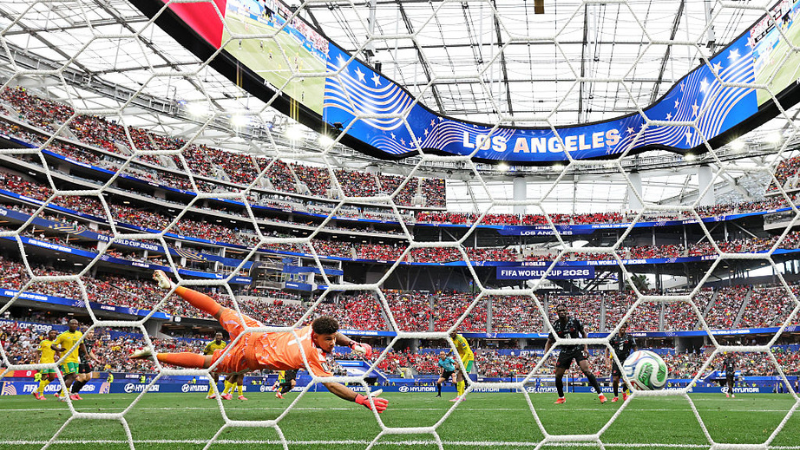
Not a single new stadium was built for this tournament, the first in the modern era to run entirely on existing venues. Host cities and their NFL, MLS, and CFL tenants poured money into the buildings they already had instead. Over $100 million was spent on MetLife Stadium's video, sound, and broadcast systems, close to CA$158 million into similar work at BMO Field, a full audio rebuild in Houston, and roughly $200 million into field and technology upgrades at Levi's Stadium in Santa Clara.
Ryan Sickman, the Gensler architect who led BMO Field's design, framed the move as building "through the lens of legacy mode."
The right test of a venue, in his view, is how well it holds up for a city "30, 50, or even 100 years from now," not how it photographs for a month of television.
Loading...
Houston's Audio Rebuild
Inside Houston's NRG Stadium, the renovation basically is the AV work. Everything else on the project list was secondary to it. LD Systems, the same integrator that wired the venue's original sound system back in 2002, returned two decades later to tear it out and start over.
Across the seating bowl, the concourse level, and the building's support spaces, crews mounted 1,194 individual Fulcrum loudspeakers, a mix of AHC443 horn-loaded arrays, CS218LWR subwoofers rated for weather exposure, and several other models in the same line, all driven through a Yamaha Rivage PM5 console with Shure Axient wireless mics on top.
The finished system weighs 40% less than the rig it replaced. This was a genuine engineering problem given that NRG's retractable roof means nothing can be hung from above it. Instead, every speaker mounts directly to the stadium's super truss.
"Our deep knowledge of NRG Stadium has allowed us to be extremely precise," LD Systems sales engineer Kevin Broussard said of the project. He pointed to the company's 20-year history with the building as the reason it landed the job again.
Before the rebuild, more than 260 of the stadium's suites relied on sound bleeding in from the bowl or a television feed running as much as four seconds behind live play. Each one now has its own Q-SYS amplifier, dedicated QSC ceiling speakers, and a control panel offering a choice between bowl audio, TV audio, radio, or a privately named Bluetooth link.
None of that was built with the World Cup in mind. It was built for Texans games, and the tournament simply arrived first.
New Jersey's Numbers
Of every US venue touched by the tournament, MetLife Stadium reports the single largest AV investment. There were upgrades to video, sound, and broadcast systems totaling more than $100 million, all engineered to keep working long after the final whistle. The four videoboards anchoring the stadium's corners were bumped to 8mm LED resolution, and a 10mm ribbon display now wraps continuously around the seating bowl.
Engineering News-Record's coverage of the project notes the venue layered in a reworked audio setup and a new distributed antenna system alongside those screens. The 1,740 seats removed from the corners to widen the pitch for FIFA's field dimensions will be reinstalled this month.
The screens and the network underneath them are not going anywhere.
Toronto's Head Start
The nearly CA$158 million that went into BMO Field's permanent upgrades bought four videoboards, each spanning 50 by 30 feet and packing in more than 5 million pixels apiece.
The same budget funded a larger video production control room, a rebuilt sound system, and a rooftop terrace that simply didn't exist before this year. While most host venues actually shrank their seating to meet FIFA's pitch requirements, BMO Field went the other way, adding close to 17,756 temporary seats to reach 45,700, the only stadium in the entire tournament to expand rather than contract.
"The game presentation is just next-level now," said Maple Leaf Sports and Entertainment program lead Stephanie Jones, describing a "360 feeling" that reaches fans regardless of where they're sitting.
The seats added for the tournament were always coming back out. The control room and sound system built alongside them were never meant to.
The Network Underneath
None of the above works without a layer almost nobody watching from home ever thinks about. Verizon designed its stadium networks around an estimated 50 terabytes of data moving through a single venue per match, adding 5G capacity across C-band and mmWave spectrum to triple or quintuple network throughput at every US host site.
That build-out also ran more than 6 million feet of new fiber optic cable through the host cities.
Brian Gorney, Verizon's managing director for professional sports and venues, said that infrastructure stays in place, functioning as a long-term digital legacy.
"These permanent infrastructure improvements, which extend beyond the stadiums, will benefit residents with enhanced coverage and capacity."
The Final Whistle
The crew in Toronto will finish pulling up its seats by the end of the month. Through August, the last of the World Cup signage will be peeled off and the illuminated BMO Field branding reinstalled.
On August 6, the Argonauts will take the field against the Calgary Stampeders under the same lighting rig that lit five World Cup group matches. The crowd will be nowhere near the 80,000 who watched Canada open its group stage in June, and nothing close to the billion screens tuned into the final.
But the videoboards overhead will do exactly what they did all summer. They'll show the replay. The crowd will be on its feet, and the same control room, the same sound system, the same 5G capacity built for a World Cup final will be running at full quality for a few thousand regulars on a Saturday night.
That's the point: the experience a fan gets at a global final is the same one they get watching their own team on an ordinary night in August.
That's the AV legacy of the FIFA World Cup.