
Women in broadcast is no longer a soft topic. It is an operations topic. If your talent pool stays narrow, your workflows stay fragile. Fragile workflows cost money, burn people out, and eventually push the business towards lowest-common-denominator setups that nobody trusts.
That was the subtext of Rise Women on Stage — #GiveToGain, hosted at EVS Headquarters in Liège on Monday 9 March 2026. Rise billed it as “connection, insight, and honest conversation”, and that was accurate on the day’s public programme and framing on the Rise Women on Stage event page and the preview in Rise News: January 2026. EVS’ own recap described a packed programme on younger audiences, industry transformation, and AI, delivered in the context of “open conversations and new connections” in its post-event LinkedIn update.
For AVIXA Europe readers, the point is not that a good event happened. The point is what it exposes: broadcast, live production, enterprise AV, and UCC now overlap in the same rooms, on the same networks, with the same expectations around reliability and quality. The staffing models have not caught up.
The number that should make every ops lead uncomfortable
Rise AV does not hide the scale of the gap. Its published sponsorship materials state that women represent 9% of the AV workforce, and only 2% are in technical roles, alongside a projected skills shortfall. Those figures appear in the Rise AV Sponsorship Opportunities 2025 deck, and the same message is repeated on the Rise AV website.
You do not need to argue about whether your local market is 8% or 12% to understand what this means in practice.
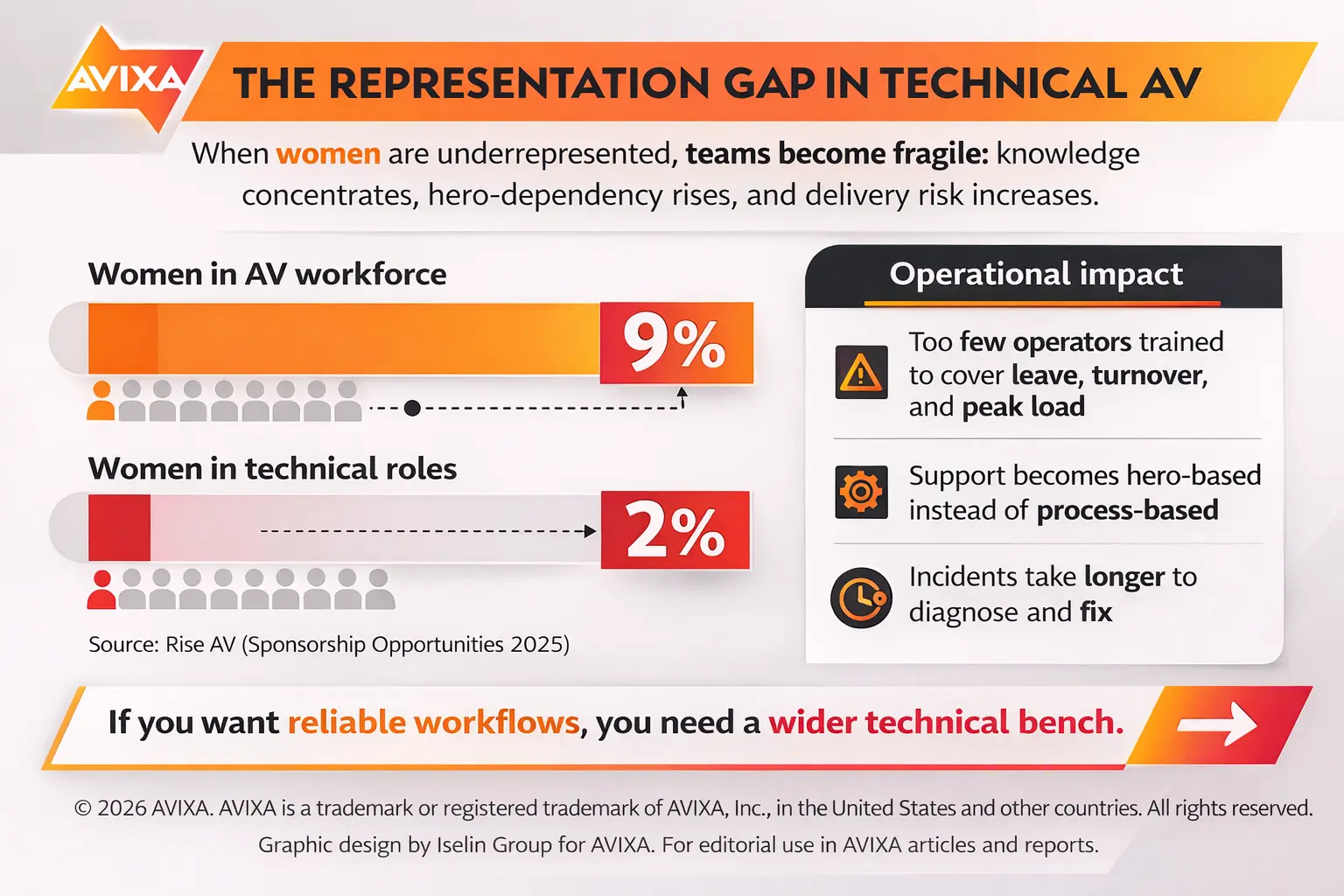
When technical roles draw from a thin pool, the work concentrates. Knowledge sits inside a few people. Those people become gatekeepers by accident. Then they become single points of failure by default. When they leave, or burn out, you do not just lose a person. You lose a system.
Rise Women on Stage made this dynamic easier to talk about without turning it into HR theatre. The day treated visibility, mentoring, and progression as tools for changing operational outcomes.
“Women in broadcast” is about the whole workflow, not one job title
A lot of industry talk still treats women in broadcast as a leadership pipeline story. Leadership matters. It is not the whole machine.
Broadcast-quality output depends on a chain: engineering, live operations, IT, security, content, and support. The moment pro AV started building rooms that behave like production environments, AV teams inherited the same truth. Reliability comes from depth and redundancy, not from one brilliant operator saving the day.
Rise’s core mission is framed around putting women at the centre of industry conversations and careers, not as a side group. That intent is clear on the Rise Women in Broadcast site. What matters for practitioners is the operational consequence: the more you widen access to technical and operational roles, the more resilient your delivery becomes.
If you run studios, streaming, room capture, or hybrid event setups, you have already seen the “hero” pattern. One person knows the routing. One person knows the VLANs. One person knows the weird audio edge case that only appears when the remote speaker joins on a certain platform build. Everyone else avoids touching anything because they do not want to break it.
That is not a culture issue in isolation. It is a design issue.
“Give to Gain” works because it names the trade
The theme lands because it is honest about what it costs.
You cannot widen the pipeline by wishing. You widen it by giving time: mentoring, shadowing, real project access, and sponsorship that moves people into higher-stakes work. That time feels expensive when schedules are tight.
Then you compare it to the cost of churn.
Churn costs real money. It shows up as rework, support load, delays, and vendor escalation fees that should never have happened. It also shows up as quality decay: teams stop aiming for excellence because the system feels too fragile to change.
“Give to Gain” is not a slogan in that environment. It is a stability strategy.
If you need a reminder that this dynamic is not limited to broadcast, AVIXA has already published the pro-AV version of the same concern in Pro AV: Are Women Fully Welcome? The piece ties representation and progression to labour market pressure and industry outcomes, not just fairness arguments.
Younger audiences are a workflow constraint, not a marketing segment
Rise Women on Stage put “reaching younger audiences” on the agenda for good reason. The demand signal is already clear in broadcast. It is now hitting enterprise video and public-facing comms with the same force.
Younger audiences reward content that feels native to the platform, paced properly, and produced cleanly. They punish anything that looks staged, slow, or sloppy. They also expect rapid iteration, not annual “digital transformation” programmes.
For pro AV and UCC teams, that changes what “success” looks like.
A room is not successful because it turns on. It is successful because it produces content people watch, reuse, and trust. That means the workflow must be repeatable, and more than one person must be able to run it without fear.
If your capture workflow depends on a specialist being in the building, you do not have a modern system. You have a fragile one.
This is where the women-in-broadcast topic intersects directly with day-to-day delivery. Diverse teams and wider access to technical roles tend to reduce silent failure modes: the “nobody else touches it” effect, the “we do not document” habit, and the “only one person can debug it” risk.
“Transformation” fails when leaders behave the same way
The day also framed what true transformation demands from leaders. Good. Most of the industry’s transformation talk stays vague because it refuses to touch behaviour.
Transformation starts when leaders stop rewarding heroics and start rewarding repeatability.
That looks like boring management discipline. It is also how you build delivery confidence.
It means documenting presets and workflows and treating that work as real work. It means protecting training time inside schedules instead of treating it as optional. It means fixing the informal networks that decide who gets the best projects. It means sponsorship that is visible, not whispered.
If leadership does not change those behaviours, no tool purchase changes the outcome.
AI value is real, but it needs governance or it becomes risk
AI was the third headline theme, and it is the easiest one to ruin with hype.
AI helps when it saves time on repetitive work: transcription, captions, translation, search tags, clip discovery, and basic QA support. Those wins are real in production environments, and they are increasingly relevant in enterprise AV because meeting capture and internal comms now run at scale.
The danger is governance drift.
The moment you introduce AI into capture and content workflows, you invite new questions. Where is the data processed? Who has access? What is retained? How do you check accuracy? Who signs off when the output becomes part of an internal record or an external statement?
If you do not answer those questions early, procurement will ask them late. Security will ask them when you are already committed. Legal will ask them when something goes wrong.
This is another reason the women-in-broadcast angle matters: the goal is not “more AI”. The goal is better workflows, with accountability that does not collapse under pressure.
Loading...
One more operational point that rarely gets said out loud: under-representation distorts what “normal” looks like on the shop floor. When a team has very few women in technical roles, women become visible by default, and visibility becomes pressure. Small mistakes feel larger. Confidence gets policed. People opt out of the hardest roles because the culture quietly treats them as auditions, not jobs. That is not a feelings argument. It is an attrition mechanism.
It also affects who gets trained. In many teams, “training” is informal: the senior engineer shows the junior who is already in the inner circle. If women are not in that circle, they miss the hidden curriculum—the shortcuts, the war stories, the unspoken rules that turn a competent operator into a reliable one. You can fix this with process. Assign shadowing as a rota, not a favour. Put runbooks and presets under version control. Make escalation learning explicit: who joins calls, who writes the post-mortem, who owns the next improvement.
What changes in your next deployment
If you want this to matter beyond a calendar event, turn it into a design rule:
Build systems that spread competence.
That means fewer “magic” configurations. More documented presets. Clear handover packs. Role-based access done properly. Training time budgeted into the support plan, not begged for after the fact.
It also means being honest in client conversations. If the client expects broadcast-grade output, they need broadcast-grade operations. That is not only equipment. It is staffing, support, and process.
Finally, if you are leading a team, treat retention as lifecycle cost. If you do not invest in progression and mentoring, you will pay later in churn and fragile delivery. The invoice always arrives. It just arrives in the form of delays, outages, and burnt weekends.
My Verdict
Rise Women on Stage worked because it treated women in broadcast as industry infrastructure, not a side campaign. The sharpest takeaway for pro AV and UCC teams is simple: a narrow pipeline produces fragile operations, and fragile operations eventually lose to cheap workarounds.
If you run systems, design them so more people can operate them. If you lead teams, budget mentoring and progression time like it is part of uptime, because it is. If you are rolling out AI tools, demand proof of time saved and define governance before the tools quietly become “the workflow”.
Skip all of that, and you will keep paying the same bill: churn, rework, and avoidable failures—just with newer kit in the rack.
Main image source: pexels / Igreja Dimensão