
A production can change a lot faster than the infrastructure supporting it.
A new show can introduce more cameras, different stage configurations, additional monitoring positions, new control requirements, or more people who need to communicate. In a large theater, venue, or entertainment facility, those changes can quickly expose the limitations of a system built around fixed signal paths and standalone technologies.
So, what happens when the production outgrows the infrastructure?
Increasingly, the answer is to rethink the infrastructure itself.
Rather than designing separate systems for video, intercom, control, I/O, and timing, production facilities are moving toward more flexible, networked architectures that allow resources to be distributed and reconfigured as workflows change.
What happens when video needs to move?
In a traditional production environment, signal paths tend to be defined by physical connections.
That works—until the production changes.
A camera that feeds one monitor for one show may need to be available somewhere else for the next. A stage manager may need different camera views from a different location. A temporary production position may suddenly need access to several sources.
A distributed video architecture changes that equation and opens up possibilities.
Instead of designing every connection as a permanent point-to-point path, video resources can be made available across the production environment and routed to the destinations that need them.
That makes the infrastructure less dependent on where a source or destination happens to be located.
The bigger benefit is flexibility. When the production changes, the signal flow can change with it.
What happens when everyone needs to see something different?
Not everyone working on a production needs the same view.
A video operator, stage manager, lighting director, conductor, and technical director can all require very different information from the same collection of sources.
A flexible monitoring architecture allows those views to be built around the job rather than around the wiring.
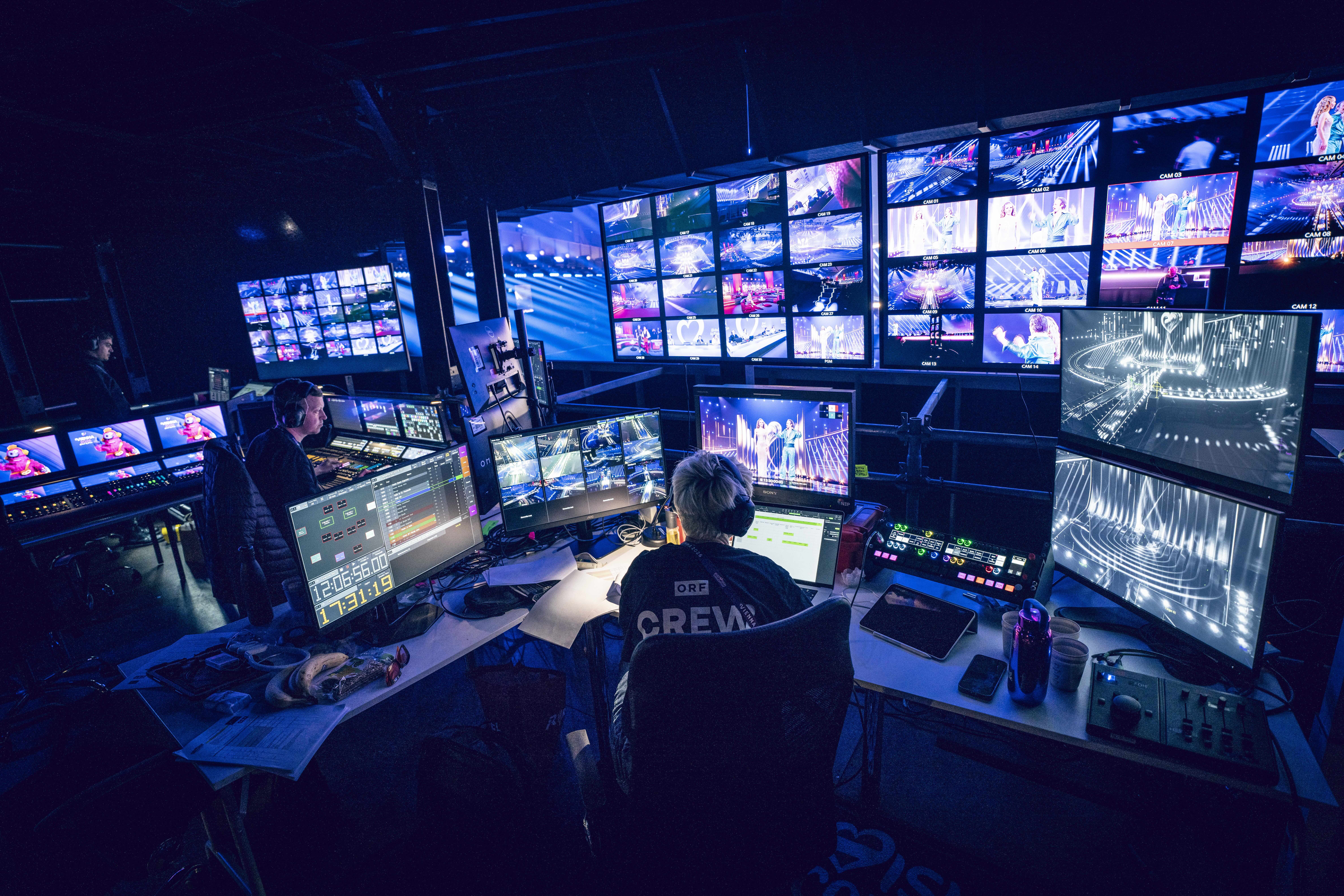
Multiple camera feeds can be combined into customized monitoring layouts, giving each operator access to the parts of the production that matter to them.
That can be particularly valuable for stage management and scenic operations, where seeing a specific area of the stage at the right moment can be more useful than simply having a wide shot.
And sometimes monitoring solves a physical problem.
A performer or operator may not have a direct line of sight to another part of the production. In those situations, low-latency video can effectively extend that line of sight.
What happens when the operator moves?
Production positions aren't always permanent.
Stage management, technical direction, engineering, and show setup can all require people to work from different locations.
If the infrastructure is built around fixed connections, moving an operator can mean moving equipment, adding cabling, or creating temporary signal paths.
A distributed architecture changes the equation.
If the required sources are already available on the network, a mobile or temporary production position can access them without requiring the entire signal infrastructure to be redesigned.
This can be particularly useful for rehearsals, setup, special events, or productions where the physical workflow changes from show to show.
The idea is simple: the workflow should be able to move without taking the infrastructure with it.
What happens when the network has to connect to the real world?
An IP-centered infrastructure doesn't mean everything becomes an IP signal.
Production facilities still have cameras, displays, audio equipment, GPIO, analog signals, timing systems, and connections to third-party equipment.
Those interfaces have to fit into the larger architecture without creating another collection of isolated systems.
Network-based I/O can provide a bridge between the IP infrastructure and the equipment that still relies on traditional signal types.
Standards-based interfaces can also make it easier to integrate third-party systems rather than locking every function into a single technology ecosystem.
Timing deserves the same consideration.
Timecode and synchronization signals still have to reach the places where they are needed, even when the rest of the infrastructure is distributed.
The network isn't the destination. It's the infrastructure connecting all the things the production actually needs.
What happens when communications become part of the workflow?
Intercom is another system that has traditionally been treated as separate from the production infrastructure.
But the people using it are the same people operating the production.
Sound, lighting, video, stage management, stage technology, engineering, and show calling can all be spread across different parts of a facility. They need to communicate while the production is running—and often while moving around the venue.
A modern communications architecture needs to account for both fixed and mobile users.
Fixed intercom panels can provide dedicated positions for key operators, while wireless systems allow crews to stay connected as they move through the production environment.
Coverage is only part of the challenge.
Building construction, equipment locations, RF conditions, and the physical movement of production personnel all need to be considered when designing wireless communications.
What happens when operators don't want another interface?
More functionality can sometimes mean more complexity for the person sitting at the control position.
A production system may have separate interfaces for routing, cameras, intercom, monitoring, and control.
That can create its own operational problem.
A unified control layer can provide access to multiple production functions through interfaces operators already use.
The objective isn't necessarily to eliminate every dedicated control system. It's to make the overall environment easier to operate.
For example, if a production team can access routing or camera-control functions from a familiar operator panel, there may be less need to move between different workstations and applications.
More capability doesn't have to mean more screens.
What happens when there is no time to troubleshoot?
This may be the most important question.
A system can look impressive on a diagram and perform perfectly during commissioning. The real test comes when it is being used every day.
Live production environments often operate under tight turnaround schedules. A theater may have only a short window between performances. A broadcast facility may have multiple productions sharing the same infrastructure. A venue may need to switch from one event to another with very little preparation time.
That puts a premium on reliability—but also on accessibility and flexibility.
Operators need to be able to find and control the resources they need quickly. Engineers need visibility into the system. And changes shouldn't require rebuilding the underlying infrastructure.
This is where a well-designed distributed architecture can make a difference.
What does all of this mean for system design?
Moving to IP isn't, by itself, the answer.
The more important question is: what does the architecture allow the production team to do?
Can signals be routed where they are needed?
Can monitoring be configured around individual workflows?
Can temporary production positions access the same resources as permanent ones?
Can legacy and third-party equipment be integrated?
Can timing and control signals be distributed alongside media?
Can communications extend across the entire working environment?
Can operators access all of that without adding unnecessary complexity?
Those are the questions that should drive the architecture decisions.
The goal isn't to put everything on a network simply because you can.
It's to create an infrastructure that gives the production team more options without giving them more problems.
A Real-World Example: Friedrichstadt-Palast
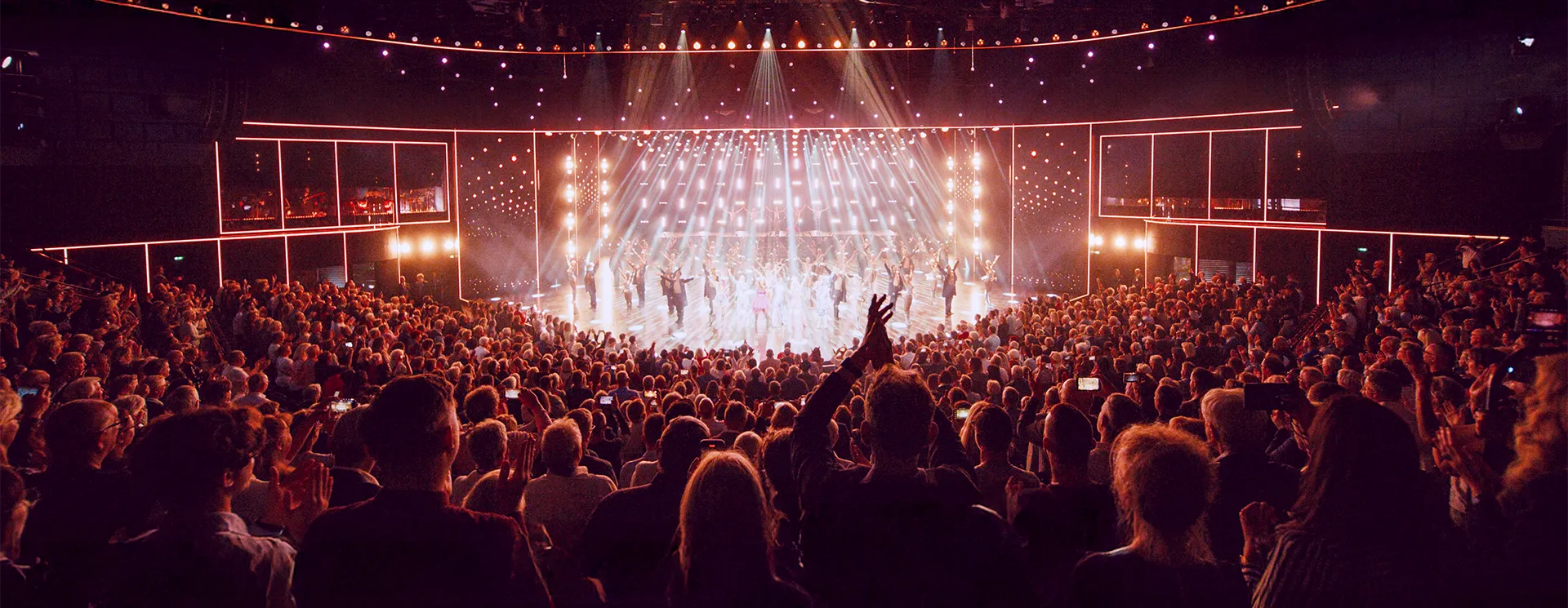
One example of this approach can be found at Friedrichstadt-Palast in Berlin.
The nearly 1,900-seat theater produces its own large-scale Grand Shows and runs seven to eight performances each week. Its technical infrastructure has to support video, stage management, communications, control, I/O, and timing across a large building constructed with thick walls, steel, and concrete.
Working with systems integrator Protones, the venue implemented an IP-centered Riedel infrastructure combining MediorNet video, Artist intercom, Bolero wireless communications, StageLink I/O, and hi human interface® control.
The video system includes MediorNet HorizoN, MicroN UHD, MediorMind, and FusioN IP gateways. It supports distributed signal routing, multiviewer workflows, and flexible monitoring for stage management and other production teams.
The communications system uses an Artist-1024 matrix with more than 30 SmartPanels and nearly 80 Bolero beltpacks, supported by approximately 40 antennas throughout front of house, stage, and backstage areas.
StageLink extends the infrastructure into analog I/O, GPIO, third-party integration, and timecode distribution, while the hi human interface control system gives operators access to production functions through SmartPanels.
It's a useful example of what happens when video, communications, control, I/O, and timing are treated as parts of one production infrastructure rather than a collection of independent systems.
And for a venue where the production changes every two years, that's the real test.
The infrastructure has to be ready for whatever comes next.
Read the full press release here!
And watch the Friedrichstadt-Palast video case study on YouTube.