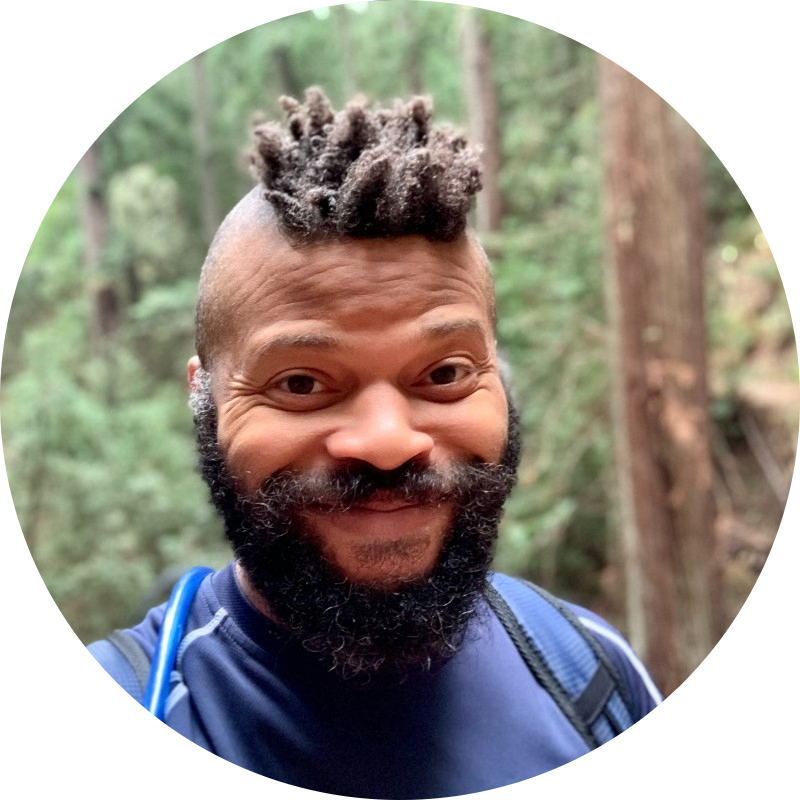
In her upcoming AVIXA Women’s Breakfast keynote, “Real Matters: Building Trust in an Unreal World,” Mariana Atencio brings a journalist’s eye and a communicator’s discipline to one of the most urgent questions facing professionals today: how do we build trust when people are increasingly unsure what, and whom, to believe? Her work across journalism, speaking, authorship, and executive communication has focused on authenticity, empathy, belonging, and the human connection that turns communication into leadership.
For an AV industry built around helping people gather, collaborate, teach, perform, heal, and connect, that message has clear resonance. Ahead of InfoComm 2026, Mariana spoke with AVIXA about what it means to be real, why trust is now a strategic asset, and how professionals can lead with more purpose in an increasingly noisy world.
Your InfoComm keynote is titled “Real Matters: Building Trust in an Unreal World.” When you say “real,” what do you most want people to hear in that word? Is it about truth, authenticity, human connection, or something that connects all three?
Real is all three, but they collapse into one word: trust. Truth is what you say. Authenticity is the alignment between what you say and who you are. Human connection is what happens when both of those things are present in a room.
When I say “real,” I am asking leaders to stop performing and start being. Audiences can sniff out a script in three seconds. The polished version of you is not building authority anymore. It is eroding it. “Real” is the new credibility.
That is why this keynote exists. In an unreal world, the most undervalued asset a leader has is the willingness to be a recognizable human in front of their own people.
The phrase “unreal world” feels especially timely in a moment shaped by AI-generated content, curated narratives, constant change, and growing skepticism. What feels different about this professional moment, and why does trust matter so much right now?
Because we have never had so much information and so little belief.
AI can write the email, generate the photo, draft the keynote, and audiences increasingly assume that it has. We have moved from an attention economy to a verification economy. The first question a customer, employee, or voter is asking is no longer “Is this interesting?” It is “Is this real?”
The leaders who will win this decade are not the ones with the slickest content. They are the ones whose people, customers, and communities know, unmistakably, that the human is still in the room. That is the work of trust. And it is the most undervalued strategic asset in any company today.
Your work often returns to the idea that what makes us different can become a source of strength. When did you first begin to understand that your own difference could become part of your power?
It was probably during the 2017 earthquake in Mexico City. I was standing outside the Enrique Rébsamen primary school in the south of the city. It had collapsed with children still inside. Parents were on their knees in the rubble. And I had to find a way to make a mother in Ohio, in Miami, in Nevada feel, in real time, in a second language, with the clock running, what those parents in Mexico were feeling.
That was the day I understood, professionally, what my difference was actually for. Not to be erased. Not to be softened. To be a bridge, between cultures, between generations, between languages, between the people who were grieving and the people who could help.
The reporting from that school ended up moving rescuers and supplies to a place that desperately needed them. None of that happens if I had spent my career trying to sound like someone else. The “difference” I had been told to manage was, in that moment, the entire job.
Difference is not a discount on your authority. It is often the source of your authority.

In your TED Talk, you describe being sent from Venezuela to summer camp in Minnesota as a child and feeling like an outsider. Looking back, what did that experience teach you about belonging that still informs your work today?
That belonging does not happen automatically. Belonging is built.
I went to that summer camp in the U.S. from Caracas for six summers in a row. And in the beginning, I tried, desperately, to fit in. To read the same teen magazines. To laugh at the same jokes. To communicate the way everyone else communicated. At that age, you genuinely believe that fitting in IS belonging. It is not.
The summer I actually felt like I belonged was the summer I stopped pretending. The minute I stopped working overtime to be someone else, I could relax, and so could everyone in the room with me. That is the part nobody tells you: pretending is exhausting for the person doing it AND for the people around them. Authenticity is not an indulgence. It is a release valve.
A playground or a summer camp is the cleanest social experiment we will ever run on ourselves. The dynamics that play out at 8 years old are the dynamics we walk back into at every offsite, every all-hands, every leadership meeting. The masks. The in-groups. The small kindnesses that change a life.
Six summers, repeated, are the foundation of every piece of work I do on authenticity and belonging today. They are why I bring this conversation into workplaces. The cost of pretending is the same at 8 or at 48. It eats the energy you were supposed to spend on the actual work.
You’ve reported on immigration, natural disasters, women’s rights, cartel violence, and other stories where people are often seen through the lens of crisis. How did that work shape your sense of empathy?
It taught me that the story is never the story. The flood, the migration, the cartel violence. Those are the headlines. The story is always the person sitting across from you, deciding in the first 90 seconds whether you are safe enough to tell the truth to.
Empathy, in journalism, is not a feeling. It is a discipline. If you cannot make a stranger feel seen quickly, you do not get the interview. You go home with nothing, and then you can’t serve your audience with the information they need. That same discipline is what separates leaders who communicate from leaders people actually follow. Empathy is operational. Treat it like a muscle, not a mood.
One of the most memorable ideas from your TED Talk is that “the only thing we all have in common is being human.” In professional environments, where people are often reduced to titles, roles, metrics, or deliverables, how can leaders help people hold on to that shared humanity?
By remembering that humanity is the currency. And right now, we are starved for it.
I have a line in my TED Talk that I keep returning to: the only thing we all have in common is being human. Everything else is a category. Title. Language. Function. Geography. Categories are useful. Categories are being disrupted right now. Leadership is the work of bringing the human back into the room.
“The only thing we all have in common is being human. Everything else is a category. ”
That is why I built a communication program that now welcomes thousands of leaders every month. I built it because I am convinced, by every story I have ever covered and every keynote I have ever given, that the single skill that will separate leaders in the age of AI is the ability to communicate as a recognizable human being.
Can you ask a better question than the algorithm? Can you actively listen when the deck has already been written? Can you look someone in the eye and close a deal in minutes because they trust your energy in the room? AI can draft the email, generate the slide, summarize the meeting. AI cannot bring purpose. Purpose is what shows up in your voice when you actually believe what you are advocating for. It is the spark. It is what makes a leader magnetic.
That is the architecture of trust I will teach our leaders during my keynote at AVIXA: leading with purpose, communicating with clarity, looking people in the eye long enough that they remember they are people. The leaders who do this, in war zones, in boardrooms, in earthquake zones, in town halls, are the ones people will follow into anything.
You’ve said that being able to reimagine yourself beyond what other people see is one of the toughest tasks of all, but also one of the most beautiful. How does that idea apply to people navigating their careers, especially in industries where they may feel underestimated, unseen, or boxed in?
The people in the room have a story about you that was written before you walked in.
You can spend your career trying to edit their story, or you can write your own and live it loudly enough that they have no choice but to update theirs. I have been told I was too Latina, too emotional, too young, too on-camera, too off-camera. None of that was ever about me. It was about the limits of someone else’s imagination.
Reinvention starts the moment you stop borrowing other people’s idea of who you should or shouldn’t be.
A lot of professionals hear words like authenticity, purpose, and empathy and agree with them in theory, but then return to workplaces driven by pressure, performance, deadlines, and difficult decisions. How do we make those values practical instead of merely aspirational?
Stop treating them like values. Start treating them like skills.
Authenticity is a muscle you train by saying the harder, more accurate sentence in a meeting. Empathy is a skill you train by listening for what the other person is not saying. Purpose is a skill you train by writing down, every Friday, the three decisions where you chose long-term alignment over short-term comfort.
Values you can frame on a wall. Skills you have to use, every single day. That is the difference.
The Women’s Breakfast description speaks to leading with purpose, communicating more effectively, and creating environments where people feel empowered to bring their best every day. What does that look like in practice, especially when people are tired, uncertain, or working inside imperfect systems?
Tired teams do not need more spreadsheets. They need clearer priorities. They need inspiration. They need one leader willing to look them in the eye and say, “I may not have all the answers, but you know I am going to guide you with heart and congruence and purpose to the right place.” That is what they need. They need trust.
What carries you through the toughest days is not a slogan. It is not a spreadsheet. It is inspiration. It is purpose. It is what I call “Permission to Be”. Permission to rest. Permission to be uncertain. Permission to re-skill, to polish the part of your work that this AI moment is reshaping. Permission to submit the idea you most truly believe in, even when it is not the most polished one.
And then, truly, at the end of the day, the only person who can give you permission to be is you. No title will hand it to you. No boss. No company memo. It is the quiet, daily decision to be yourself out loud, to lead from the version of yourself you actually respect, instead of the version you think the room is asking for.
Communication is how all of that comes out. Permission is the inner work. Communication is the expression. That is why my Substack is literally called Permission to Be. Every week, I send executives, and especially female executives, the tools to communicate with clarity, gain better visibility at work, and lead from who they actually are. It is permission to lead in this moment. Permission to be human in an AI world.
“Technology is now the loudest voice in most rooms. The responsibility of this industry, and every leader in it, is to make sure the human voice is still the one people leave remembering.”
You have worked across journalism, media, speaking, authorship, and entrepreneurship. How have authenticity and trust helped you navigate reinvention across different chapters of your career?
Every chapter of my career has looked, from the outside, like a leap. News anchor, author, speaker, founder, executive coach, creator. In truth, they are all the same job: earn someone’s attention, earn their trust, help them arrive at the truth, inspire them to give their best, live their fullest, and do it again tomorrow.
Authenticity is what makes that repeatable across formats. The medium changes. Your connection and service to the audience does not.
That, to me, is the only real career strategy.
For InfoComm attendees who may not know your work yet, what do you hope they understand about the connection between communication and leadership before they walk into the room?
That communication is no longer a soft skill. It is THE differentiator.
Imagine two leaders with identical credentials. Same degrees. Same résumés. Same numbers. One of them communicates with clarity, with magnetism, with the courage to be a little fallible in front of their own people. The other does not. There is no contest. The first one gets followed.
Especially now. We are drowning in noise: AI-generated content, polished narratives, perfectly designed decks. The leaders who stand out are not the ones with more content. They are the ones whose people can clearly hear them, clearly trust them, and clearly remember what they said the next morning.
That is the connection between communication and leadership: you cannot lead what you cannot reach. And in a noisy world, reaching people is the entire game.
The AV community is built around helping people communicate, gather, collaborate, teach, worship, perform, heal, and connect. From your perspective, what responsibility do communicators, technologists, and leaders have in shaping more human spaces?
The AV industry is, quite literally, in the business of building rooms where humans gather. Every microphone, every screen, every live stream is an act of inviting people in. That is not a technical job. That is a moral one.
Technology is now the loudest voice in most rooms. The responsibility of this industry, and every leader in it, is to make sure the human voice is still the one people leave remembering.
You are not in the AV business. You are in the trust business. And in the age of AI, that is the only business worth being in.
You’ve spent much of your career reminding audiences that empathy, authenticity, and human connection are not soft ideas. But we’re living through a moment when fear, distrust, and self-interest can feel louder, faster, and better rewarded. For people who still believe in a more human way to lead and live, how do we keep choosing it without becoming discouraged?
By remembering what I have seen at the worst moments humans live through.
I have reported from earthquakes, hurricanes, mass shootings, and conflict zones, from Haiti to the Syrian border, from China to communities here at home ripped apart in a single afternoon. In every one of those places, after the cameras leave and the news cycle moves on, what stays is people choosing each other. Neighbors digging neighbors out of rubble. Strangers feeding strangers. Mothers holding the children of mothers they have never met.
The human way to lead and live is not the soft option. It is the option that survives. In moments of despair, every other system fails: power, infrastructure, governments, the markets. People do not. That is not sentimentality. That is reporting.
So when discouragement comes, and it will, I do not look at the algorithm. I look at what humans actually do when everything else collapses. That is the data set. Automation cannot reach into the rubble. Empathy can.
I want to take that into the modern workforce. Into the everyday. In a workforce that is increasingly tired, lonely, and over-optimized, humanity is not the consolation prize. It is the way out. The thing you are most discouraged about choosing right now is the thing you will be most grateful you kept.
Mariana’s answers make a clear case that trust, empathy, and human connection are not separate from the work of communication. They are what make communication matter. For InfoComm attendees working in an industry built around helping people gather, listen, learn, collaborate, and connect, that perspective offers a meaningful preview of what she will bring to the AVIXA Women’s Breakfast.
Join us at the AVIXA Women’s Breakfast
Register for the AVIXA Women’s Breakfast at InfoComm 2026 to hear Mariana Atencio present “Real Matters: Building Trust in an Unreal World.”