Updated on May 2, 2026
Where It Works—and Where It Doesn’t
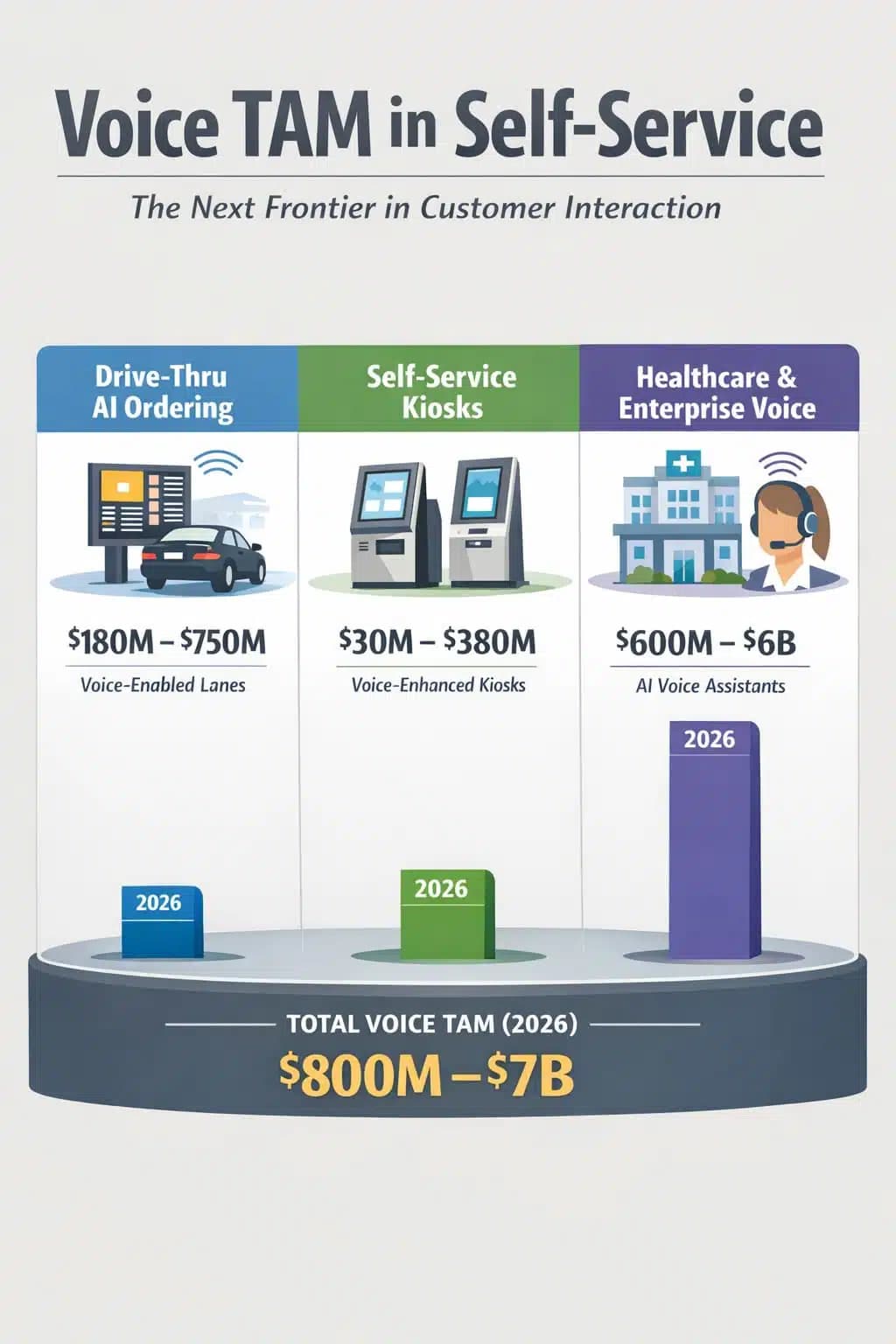
Voice is rapidly emerging as a new interface layer in self-service—but adoption is not happening evenly across use cases. The Industry Group has posted overview of Voice in self-service and included is VAIMS scoring and worksheet assessment for voice readiness.
The assumption that voice will replace touchscreens across kiosks is incorrect. In reality, voice is gaining traction in environments that are high-volume, time-sensitive, and constrained by labor.
The clearest example is the quick-service restaurant drive-thru. Here, voice aligns with operational needs—fast ordering, minimal friction, and limited decision complexity. It is no surprise this segment is leading adoption.
Beyond QSR, voice is gaining ground in service triage applications such as healthcare intake and enterprise support. In these environments, the value is less about convenience and more about workflow efficiency—reducing human intervention while maintaining throughput.
The AVIXA Angle: Voice Is an AV + Data Problem
For the pro AV community, the shift to voice introduces a different kind of design challenge.
Voice is not just an interface—it is a systems integration problem spanning audio, visual, and data layers.
1. Audio Capture Is Mission-Critical
Far-field microphones must perform in:
outdoor environments (drive-thru noise, weather)
high ambient noise spaces (retail, healthcare)
Beamforming, echo cancellation, and noise suppression become core infrastructure—not optional features
👉 Poor audio = failed experience. Every time.
2. Visual Systems Become More Important, Not Less
Voice increases reliance on visual confirmation layers:
Digital menu boards
Real-time order displays
Dynamic signage for upsell and personalization
👉 This reinforces a key point for AV integrators:
“Voice drives <strong>more demand for digital signage</strong>, not less.”
3. Real-Time Content Synchronization
Voice systems must stay in sync with:
pricing
promotions
inventory
customer context
That requires:
CMS platforms (like digital signage networks)
API-driven data flows
low-latency updates across screens
👉 This is where AV meets enterprise IT.
4. Multimodal Experience Design
The winning deployments are not “voice-first”—they are multimodal by design:
Voice for input
Visuals for confirmation and persuasion
Data systems for orchestration
For AV professionals, this shifts the role from:
display deployment
toexperience orchestration
5. Edge Compute and AI Processing
Voice systems increasingly rely on:
edge AI (for latency and reliability)
local processing for speech and vision
hybrid cloud architectures
👉 This brings AV infrastructure closer to compute infrastructure
Where Voice Still Struggles
Inside traditional kiosks—retail browsing, wayfinding, and complex transactions—voice remains situational.
Customers need:
comparison
exploration
confidence
These are still better served visually.
Bottom Line
Voice is not replacing touch or screens.
It is expanding the interface stack.
The real opportunity for the AV industry is not microphones—it is:
integrating voice into digital signage ecosystems
synchronizing content and AI decisioning
designing environments where audio, visual, and data operate as one
Final Word
Voice is not the future of self-service on its own.
But as part of a multimodal system, it is becoming essential.
“The winners won’t be those who deploy voice.<br>They will be those who integrate it into the operating model.”
Addendum
Voice in Self-Service original article — Concise Outline
1. Core
Voice is emerging as a new modality layer
Adoption is real—but highly uneven
Not a kiosk story → an operations story
2. Where Voice Is Scaling (Ranked)
#1 Drive-Thru (Dominant)
Clear market leader
High volume + constrained workflows
Voice becoming default interface
#2 Service Triage (Healthcare / Enterprise)
Intake, routing, support automation
Voice = front door filter
#3 In-Store / Kiosk (Selective)
Limited adoption
Works only in narrow use cases
3. Why Drive-Thru Wins
Fixed menu → predictable vocabulary
Linear workflow → low complexity
Labor pressure → immediate ROI
Customers already trained for voice
👉 Only segment approaching true scale deployment
4. Why Kiosks Lag
Browsing vs execution problem
Need for:
visual confirmation
comparison
user confidence
👉 Voice alone cannot replace screen-based UX
5. Key Inflection Point
Touchscreens have peaked
Voice + gesture = next wave of interaction
But not replacement → additive modalities
6. Operational Reality (Critical Insight)
Voice success depends on:
backend integration (POS, pricing, inventory)
workflow orchestration
error handling + fallback
👉 Not a UI problem → system design problem
7. Emerging Model
Shift toward multimodal stack
voice + visual + data + AI
Voice becomes:
input layer
routing layer
optimization layer
👉 Industry moving beyond single-interface design
8. Bottom Line
Biggest growth is before the kiosk, not at it
Drive-thru = primary voice interface
Enterprise/healthcare = next wave
Kiosks = multimodal only
“Voice will not replace touch<br>It will sit alongside it as part of a broader system”