
Updated on June 8, 2026
Why Video Latency Matters
As businesses, broadcasters, healthcare providers, educational institutions, and content creators increasingly rely on real-time video communications, understanding video latency has become more important than ever. Whether you're streaming a live event, deploying an AV-over-IP network, conducting a remote medical consultation, or managing a professional broadcast workflow, latency can directly impact user experience and operational efficiency.
Video latency refers to the delay between an event occurring and that event being displayed on a screen. While a delay of a few milliseconds may seem insignificant, latency can quickly accumulate across cameras, capture devices, encoders, networks, decoders, and displays. The result can range from minor synchronization issues to significant communication challenges in mission-critical environments.
The Shift Towards IP-Based Video
The rapid adoption of technologies such as NDI®, SRT, RTMP, WebRTC, and Low-Latency HLS has transformed how organisations distribute video. Traditional SDI-based workflows are increasingly being replaced by network-based infrastructures that offer greater flexibility, scalability, and cost efficiency.
However, each protocol introduces different levels of latency, making it essential for AV professionals and IT teams to understand the trade-offs between quality, bandwidth consumption, reliability, and responsiveness.
Typical Latency Expectations
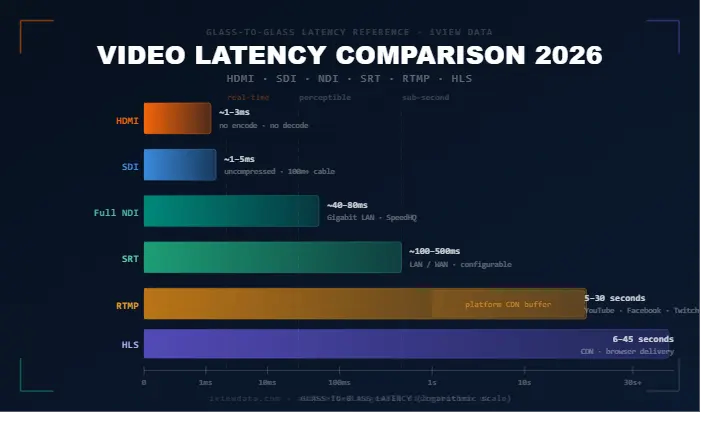
The table below provides a general overview of latency performance across common video transport technologies.
Technology | Typical Latency | Common Applications |
|---|---|---|
NDI | 16ms – 100ms | Live production, AV-over-IP |
SRT | 100ms – 2000ms | Remote contribution, internet streaming |
WebRTC | Under 500ms | Video conferencing, collaboration |
RTMP | 2 – 5 seconds | Live streaming platforms |
HLS | 6 – 30+ seconds | Large-scale content delivery |
Low-Latency HLS | 2 – 5 seconds | Modern streaming platforms |
Actual performance varies depending on hardware, network conditions, encoding settings, and workflow design.
Choosing the Right Low-Latency Solution
There is no single technology that fits every deployment. A broadcaster may prioritise image quality and reliability, while a healthcare organisation may require near real-time video for remote consultation. Similarly, corporate environments may focus on low-latency collaboration, while content creators often need the lowest possible delay between production and audience engagement.
Understanding where latency is introduced and how various protocols compare is essential when selecting the right solution for your organisation.
Read the Full Video Latency Comparison Guide
For a detailed breakdown of latency measurements, protocol comparisons, real-world use cases, optimisation techniques, and recommendations for professional AV deployments, read the complete guide from iView Data:
Read the full article: https://iviewdata.com/video-latency-comparison/
In the sections that follow, we'll explore how latency affects different industries, compare the performance of leading video transport technologies, and identify practical ways to minimise delays across modern video workflows.