
Updated on March 23, 2026
Good to Know Regarding Restaurants and Self-Service
Kiosks, AI, Payments & the Modern Restaurant Stack
Restaurants are no longer asking if they should deploy self-service—they are deciding how fast they can scale it.
Labor pressure, rising costs, and customer expectations for speed have pushed digital ordering from “nice-to-have” to core infrastructure. Whether it’s a self-order kiosk in a QSR, AI voice ordering in the drive-thru, or mobile-first pickup with smart lockers, the interface between customer and restaurant is being redefined.
At The Industry Group (TIG), we view this shift as structural—not cyclical.
Self-service is now the digital front door for restaurants.
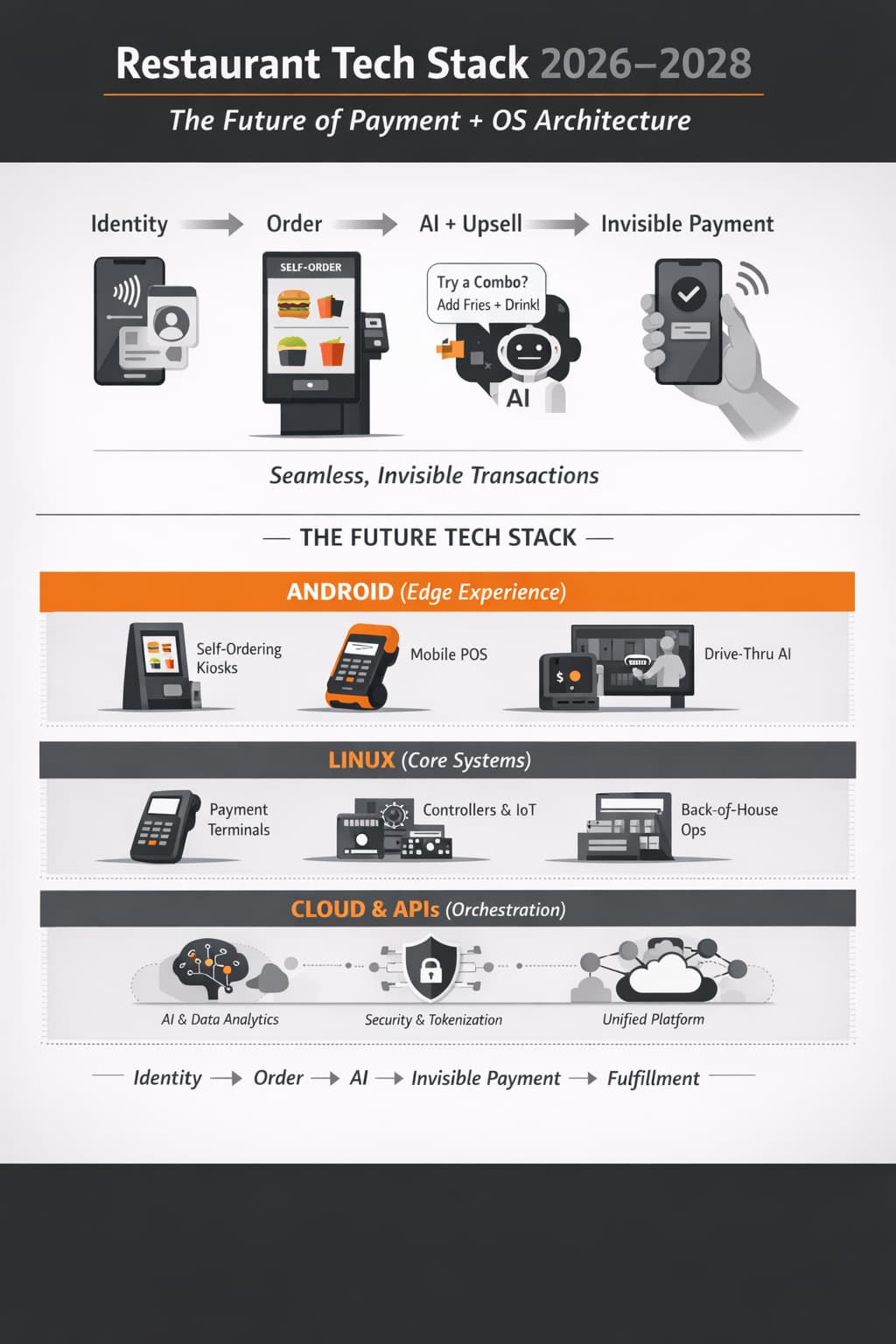
Executive Snapshot (2026)
15–30% average ticket uplift with self-order kiosks
20%+ throughput improvement in high-volume QSR environments
77%+ of transactions cashless in North America
China leads globally in deployment density and automation scale
ROI payback typically achieved in 6–18 months
The Restaurant Self-Service Stack
The biggest mistake buyers make is thinking in terms of “kiosks.”
The reality is a three-layer stack:
1. Hardware Layer
Physical infrastructure that enables interaction
Freestanding and countertop kiosks
Outdoor/drive-thru units
Digital menu boards
Payment terminals (EMV/contactless)
Edge AI compute (Intel Core Ultra, ARM, NVIDIA Jetson)
KIOSK Information Systems – Kiosks & Software
Printers, scanners, cameras
2. Software Layer
3. Services Layer
What actually makes it work at scale
Installation & site surveys
Field service / break-fix
SLA management
Remote monitoring
Content updates
Analytics and optimization
Key Takeaway
“Hardware gets deployed. Software runs the experience. Services determine success.”
Types of Restaurant Self-Service
Self-Order Kiosks (QSR / Fast Casual)
Highest ROI segment
Drives ticket size and order accuracy
Ideal for high-traffic environments
Drive-Thru Automation
AI voice ordering
Digital confirmation boards
Queue optimization
Table Ordering / Hybrid Models
QR + kiosk combinations
Reduces waitstaff dependency
Smart Pickup & Lockers
Off-premise + delivery optimization
Reduces congestion at counters
Unattended Retail / Vending
Expands restaurant footprint beyond store
24/7 micro-market capability
Reality Check
No single model wins everywhere.
Winning operators deploy hybrid strategies.
Payments & POS Integration
Payments are no longer just a feature—they are a gating factor.
Core Requirements:
EMV compliance
Contactless (NFC, Apple Pay, Google Pay)
Mobile wallet support
Offline transaction capability
Integration Challenges:
Legacy POS systems
Closed APIs
Certification requirements
OS Trends:
Android: growing fast (cost + flexibility)
Windows: enterprise stability
Linux: niche but efficient
Key Takeaway
“The kiosk is only as good as its POS integration.”
AI in Restaurants (2026 Reality)
AI is no longer experimental—it’s operational.
Where AI is working today:
Voice AI (Drive-Thru)
Automated ordering
Labor reduction + consistency
Computer Vision
Queue detection
Theft/fraud monitoring
Personalization Engines
Upsell recommendations
Dynamic menus
Edge AI vs Cloud
Edge = lower latency, better privacy
Cloud = training + scale
TIG POV
“Edge AI is becoming mandatory for high-volume restaurant environments.”
ROI & Business Case
This is where decisions get made.
Typical Gains:
Metric | Impact |
|---|---|
Average Ticket | +15–30% |
Throughput | +20% |
Order Accuracy | Significant improvement |
Labor Efficiency | Redeployment vs reduction |
Sample ROI Model
Kiosk cost: $3,500–$7,000
Monthly lift per store: $2,000–$8,000
Payback: 6–18 months
Key Takeaway
“Kiosks don’t replace labor—they <strong>increase revenue per labor hour</strong>.”
Global Market Comparison
United States
Focus: labor efficiency + POS integration
Strong QSR adoption
China
Fully automated ecosystems
Super apps + dense deployments
Global leader in scale
Europe
Compliance-driven
Strong accessibility focus
Slower but structured rollout
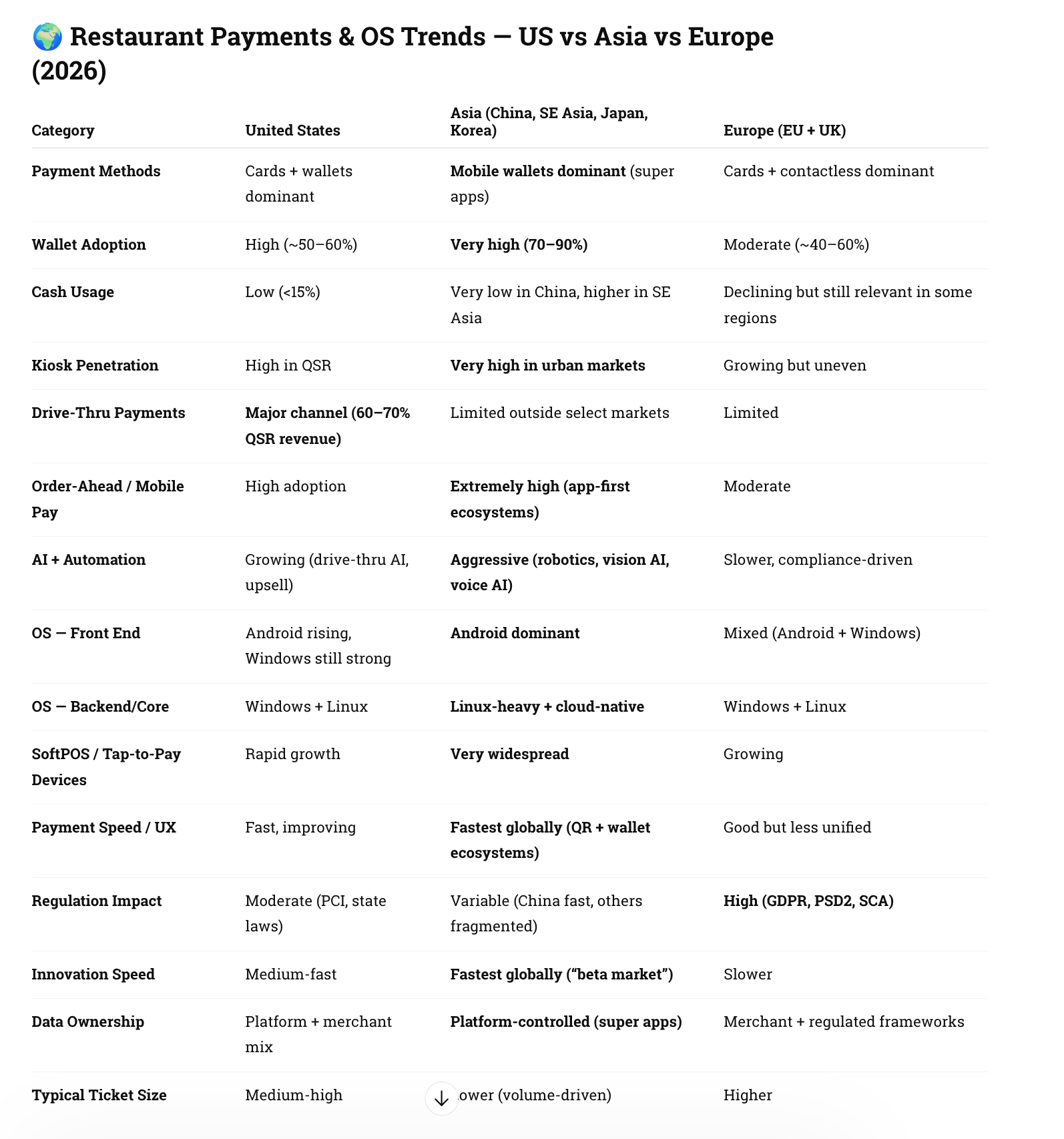
Insight
“China is the “future state,” the US is the “business case,” and Europe is the “compliance model.””
Compliance & Accessibility
Critical Areas:
ADA / ABA (US)
PCI DSS 4.0
GDPR (EU)
Common Mistakes:
Inattention to ABA standards
Incorrect reach ranges
Ignoring accessibility UX
Weak payment security implementation
Key Takeaway
“Compliance is not optional—it is design input.”
Deployment Playbook
Proven rollout sequence:
Define business objectives
Map customer journey
Select hardware/software
Conduct site surveys
Pilot deployment
Scale rollout
Common Failure Points:
Poor integration planning
Underestimating service requirements
Ignoring site constraints
Vendor Ecosystem
Key Categories:
Kiosk manufacturers
Software providers
POS vendors
Payment providers
Integrators
Examples
Trends (2026–2028)
AI-native kiosks
Voice-first ordering
Cashless dominance
Edge AI standardization
Retrofit vs replace strategies
❓ FAQ
Are kiosks worth it?
Yes—if throughput and ticket size matter.
How many kiosks per store?
Typically 2–6 depending on volume.
What is typical cost?
$3K–$7K per unit plus software/services.
Do kiosks replace staff?
No—staff shifts to higher-value roles.
Related Resources
Final Takeaway
Restaurant self-service is no longer a technology decision.
It is a business model decision.
Operators that embrace it are seeing:
Higher revenue
Better customer experience
More scalable operations
Those that don’t will struggle to compete.
Work With The Industry Group
Explore partner ecosystem
Join TIG
Access Buyer Intelligence
Participate in industry events
More Resources
Payment
Standards
AI
Service
Case Studies For Kiosks – The Good, the Bad and the Ugly
Learn from the Best and the Worst Kiosk case studies can be difficult to locate. Most companies with a strong case …
Part Two — SMB Service Selection Framework for Kiosks
Part Two – Selection Framework Editors Note — This post has two main sections — Writer+AI and Writer Only— How AI …
PART One — SMB Service Selection Framework for Kiosks
Introduction: Why Service Decisions Matter More Than Hardware Price Editors Note — This post has two main sections — Writer+AI and …
End of content